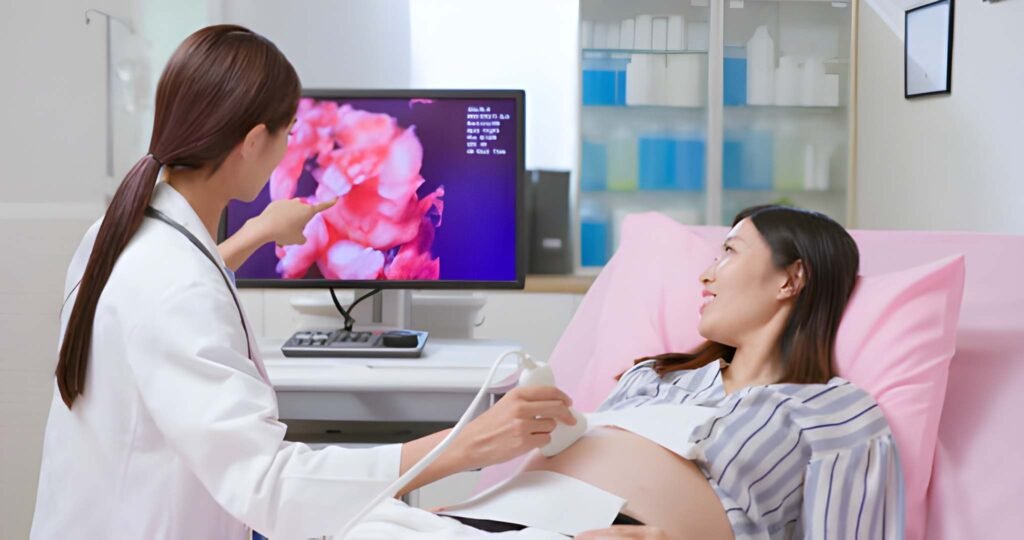
Seeing the Unseen: The Advanced World of Fetal Imaging
3D and 4D Pregnancy Ultrasound: Technology, Clinical Value, and the Maternal-Fetal Bond
Table of Contents
Defining the Technology: From 2D to 4D
Prenatal ultrasound technology has advanced significantly from the initial two-dimensional (2D) images used for dating and essential anatomical checks. The introduction of three-dimensional (3D) and four-dimensional (4D) scanning represents a quantum leap in both diagnostic capability and the parental experience.
How Volume Data is Captured
Unlike 2D ultrasound, which captures a single, flat slice of tissue in real-time, 3D technology works by capturing a rapid sequence of two-dimensional images. The ultrasound machine then reconstructs this volume data using complex software to generate a lifelike, three-dimensional surface rendering. This provides depth, height, and width, making fetal features—such as the face, hands, and feet—clearly recognizable.
The Difference in Dimension
The distinction between 3D and 4D is simply the inclusion of time. **3D ultrasound** provides a still, volumetric image, like a photograph. **4D ultrasound** adds the element of time, showing the 3D volume in continuous, real-time motion, allowing parents and clinicians to observe fetal actions like yawning, sucking their thumb, or opening their eyes.
Clinical Purpose: Beyond the Picture
While often utilized for their "keepsake" value, 3D and 4D ultrasounds serve vital clinical roles, supplementing the essential information gathered during the standard 2D anatomy scan. They enhance the visual confirmation of intricate fetal structures.
Enhancing Diagnostic Clarity
The volumetric view offered by 3D imaging allows clinicians to rotate and examine structures from multiple angles that are difficult or impossible to visualize with flat 2D slices. This is particularly valuable when assessing the relationship between structures or confirming the integrity of surfaces.
The Core Diagnostic Tool: It is crucial to understand that **2D ultrasound remains the standard of care** for initial anomaly screening, dating, and measuring essential internal organs. 3D/4D scans are typically supplementary tools used to clarify specific findings or enhance the patient experience.
Optimal Timing for Best Visualization
The quality of 3D and 4D images depends heavily on several factors, most importantly the stage of gestation, the amount of amniotic fluid, and the baby's position.
The Best Window for Surface Rendering
The clearest images of the baby’s face and features are usually captured during the **late second and early third trimesters**, typically between **Weeks 27 and 32**.
- Before Week 27: The baby generally lacks sufficient subcutaneous fat, leading to a skeletal, "unfilled" appearance that can be unnerving for parents.
- After Week 32: The baby is larger, and the amount of surrounding amniotic fluid (the fluid that provides the clear "window" for the sound waves) decreases. The baby may also be deeply engaged in the mother's pelvis or facing the placenta, blocking the view.
Interactive: 2D vs. 3D vs. 4D Comparison
The three dimensions of fetal imaging each offer unique information and serve distinct purposes within prenatal care. Click the labels below to learn the specific function of each technology.
The Emotional Impact: Fostering the Bond
For many parents, seeing a 3D or 4D image is a transformative moment that profoundly accelerates the emotional connection to the unborn child. The detailed features shift the perception from an abstract concept to a recognizable individual.
Reducing Anxiety and Increasing Reality
Studies suggest that seeing the baby's face clearly can be highly therapeutic, particularly for fathers or non-carrying partners who may struggle to connect with the pregnancy early on. The realism provided by the volume rendering makes the baby seem instantly more real, which helps reduce anxiety about the unknown and aids in the mental preparation for parenthood.
Safety, Ethics, and Keepsake Scans
Ultrasound technology, when used diagnostically by trained medical professionals, is considered safe. However, the rise of commercial "keepsake" 3D/4D studios raises ethical and safety questions.
The FDA Position on Non-Medical Use
The Food and Drug Administration (FDA) discourages the use of ultrasound for non-medical purposes, such as generating souvenir images or videos. While the energy output used in 3D/4D is comparable to 2D, non-diagnostic scans may involve unnecessarily extended exposure times and are often performed by individuals without medical training. The primary concern is the cumulative, long-term effect of thermal (heat) or cavitational (bubble formation) energy on fetal tissue, particularly when exposure time is prolonged.
The consensus among medical specialists is that **diagnostic use is safe and warranted**; extended or repeated non-medical exposure should be avoided.
Diagnostic Advantages in Anomaly Screening
In addition to surface anatomy, 3D imaging provides crucial structural insight, particularly regarding the skeletal system and fetal volume measurement.
Visualizing Skeletal and Craniofacial Anomalies
- Cleft Lip and Palate: 3D rendering provides superior visualization of the nasal passages and the roof of the mouth, helping clinicians accurately diagnose and counsel parents about facial clefts earlier than with 2D alone.
- Skeletal Defects: By rendering bones in three dimensions, the technology is better suited to confirm complex skeletal malformations or limb anomalies.
- Placental Abnormalities: The 3D view can assist in mapping the relationship between the placenta and the cervix with greater precision, aiding in the diagnosis of conditions like placenta previa.
| Fetal Feature | 2D Role | 3D/4D Role |
|---|---|---|
| Heart | Primary measurement of chambers and blood flow (essential). | Limited; 2D Doppler is preferred for function. |
| Face/Profile | Basic bone structure check. | **Confirmation of surface anomalies** (e.g., cleft lip). |
| Fetal Behavior | Movement observed as displacement. | **Real-time observation** of facial expressions, swallowing, and yawning. |
Socioeconomic Factors and Access
Access to advanced 3D/4D ultrasound technology in the US is often split along socioeconomic lines, depending on whether the scan is diagnostic or elective.
Cost of Elective vs. Diagnostic Scans
- Diagnostic Use: If the OBGYN orders a 3D scan to clarify a suspected anomaly (such as a concern identified on the 2D anatomy scan), it is **medically necessary** and is typically covered by insurance with applicable co-pays or deductibles.
- Elective Use: Non-medical, purely aesthetic "keepsake" scans are performed at private imaging centers and are paid for entirely **out-of-pocket** (typically $100-$300). This cost structure restricts the bonding benefit of 3D/4D imaging for low-income populations.
The technology offers immense value, both clinically and emotionally. Understanding its proper use and the limitations of non-medical scanning ensures that expectant parents receive the maximum benefit safely, aligning technology with the sacred process of welcoming a new life.