The Missed Period and Beyond
4th Week Pregnancy hCG Levels: Understanding Your Confirmed Result and Ranges
Table of Contents
- Defining Week 4: The Missed Period Milestone
- The Biological Source of hCG at 4 Weeks
- Expected hCG Ranges and Interpretation
- The Critical Doubling Rate Calculation
- Clinical Applications: Home Test vs. Beta Test
- HCG as a Warning Signal: Slow Rise or Fall
- Interactive Calculator: Projecting Your hCG Rise
Defining Week 4: The Missed Period Milestone
The 4th week of pregnancy is the most commonly recognized point of confirmation. Medically, 4 weeks gestation is equivalent to approximately 14 days past ovulation (14 DPO) and coincides precisely with the day the next menstrual period is expected to arrive. By this time, the blastocyst has successfully completed implantation into the uterine lining.
This establishment of the embryo triggers the production of Human Chorionic Gonadotropin (hCG), the hormone that makes a positive pregnancy test possible. A positive result in the 4th week shifts the status from "trying to conceive" to "expectant," moving the focus immediately to initiating prenatal care.
The Biological Source of hCG at 4 Weeks
The presence of hCG in the body is the single most reliable indicator of pregnancy. Understanding its origin provides context for interpreting the rapid rise seen in the 4th week.
The Trophoblast and Placental Foundation
HCG is produced by the trophoblast—the outer layer of cells of the blastocyst that eventually forms the placenta. This hormone is crucial because its release signals the mother's body to sustain the pregnancy:
- Progesterone Maintenance: HCG takes over the job of signaling the corpus luteum (the remnant of the follicle) to continue producing high levels of progesterone. Progesterone is the vital hormone that maintains the uterine lining and prevents menstruation.
- Symptom Trigger: The rapid increase in hCG is the primary driver of early pregnancy symptoms such as nausea, vomiting, heightened sense of smell, and amplified fatigue.
Expected hCG Ranges and Interpretation
The absolute hCG level at 4 weeks gestation (or 14 DPO) can vary dramatically among healthy pregnancies due to differences in implantation timing and individual maternal hormone profiles. Therefore, a single number is less important than the rate at which that number increases.
Quantitative hCG Range at 4 Weeks (14 DPO)
The following table provides the typical expected range for quantitative serum hCG (Beta hCG) tests performed in the 4th week of pregnancy:
| Gestation (LMP) | Days Past Ovulation (DPO) | Typical hCG Range (mIU/mL) |
|---|---|---|
| 3 Weeks | 7 DPO | 0 – 5 |
| 4 Weeks | 14 DPO (Missed Period) | 5 – 426 |
| 5 Weeks | 21 DPO | 18 – 7,340 |
The lower threshold of 5 mIU/mL is generally considered the clinical marker for a confirmed pregnancy in a serum blood test, though most home tests require 25 mIU/mL or more. The wide variation emphasizes that comparison between individuals is meaningless; only the internal doubling rate matters.
The Critical Doubling Rate Calculation
The most crucial information derived from hCG testing in the 4th week is the doubling rate. In a healthy, progressing single pregnancy, hCG levels should double approximately every 48 to 72 hours. This rate confirms that the trophoblast cells are multiplying correctly and establishing a viable placenta.
Doubling Rate Example
If a woman's initial hCG reading at 4 weeks (14 DPO) is 100 mIU/mL, the expected range for the follow-up test two days later is:
Initial Reading (Day 0): 100 mIU/mL
Expected Reading (Day 2): 200 mIU/mL – 300 mIU/mL
If the level increases correctly, the pregnancy is progressing well. The provider may stop monitoring hCG once the heart activity is confirmed via ultrasound, usually around 6 to 8 weeks, as the heartbeat becomes a stronger indicator of viability.
Clinical Applications: Home Test vs. Beta Test
The 4th week of pregnancy often involves using both home tests and professional blood tests to confirm the result.
Home Pregnancy Tests (HPTs)
A positive home test during the 4th week is a strong qualitative confirmation (yes/no). However, due to variations in test sensitivity and urine concentration, a faint line should always be followed up clinically. The darkness of the line visually represents the hCG level being above the 25 mIU/mL threshold.
Quantitative Serum hCG (Beta Test)
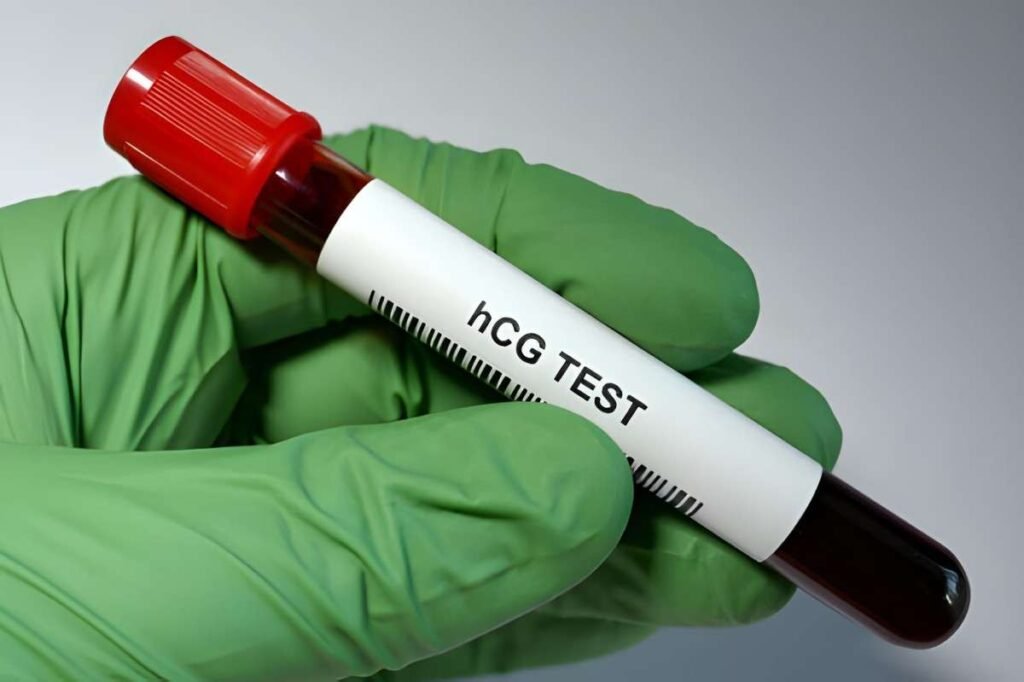
The blood test, or Beta hCG test, is quantitative; it provides the precise number of the hormone (mIU/mL). Clinicians order this test when:
- There is a history of miscarriage or ectopic pregnancy.
- The home test is positive, but the mother is experiencing unusual symptoms (e.g., pain, spotting).
- The pregnancy resulted from fertility treatments (IVF/IUI) and requires close monitoring of the hormone trajectory.
HCG as a Warning Signal: Slow Rise or Fall
While hCG provides strong reassurance, deviations in the expected doubling rate during the 4th and 5th weeks serve as critical warning signals for potential complications.
| HCG Trend | Clinical Indication | Necessary Action |
|---|---|---|
| Slow Doubling (e.g., 100 hours) | Possible Miscarriage, Ectopic Pregnancy | Close monitoring, transvaginal ultrasound required. |
| Falling Levels | Likely Miscarriage (Chemical or Clinical) | Counseling and management of pregnancy loss. |
| Extremely High Levels | Possible Multiples (Twins, Triplets), Molar Pregnancy | Early ultrasound confirmation of fetal number and placental status. |
Interactive Calculator: Projecting Your hCG Rise
Use this tool to calculate what your hCG level should be two days after your first positive blood test, assuming a perfect doubling rate (48 hours).
Projected hCG Level (48 Hour Doubling)
Enter your initial hCG and days passed to see the projected level.
Conclusion: HCG Confirms the Journey
The 4th week of pregnancy is the pivotal moment of confirmation, driven entirely by the production of hCG. While the absolute number varies widely, the confident interpretation relies solely on the doubling rate over a 48 to 72-hour period, confirming the embryo's healthy progression. Upon confirmation via home test, the immediate action is to contact a healthcare provider for definitive quantitative blood work, initiate folic acid, and establish the foundational maternal support necessary for the journey ahead.