Window to the Soul: The Psychology of Newborn Vision
Exploring how visual development shapes the infant mind and early attachment.
- 1. The First Glance: Physical Capabilities at Birth
- 2. The Psychological Blueprint: Why We Seek Faces
- 3. Decoding Contrast: The High-Octane Fuel for Brain Growth
- 4. The Social Loop: Eye Contact as Primitive Language
- 5. Developmental Milestones in Visual Psychology
- 6. Optimizing the Visual Environment for Cognitive Health
- 7. The Long-Term Impact of Early Visual Engagement
The First Glance: Physical Capabilities at Birth
When a child enters the world, their visual system is the least developed of all their senses. While hearing is nearly fully functional by the third trimester of pregnancy, the visual cortex and the physical structures of the eye require environmental input to finish their "wiring." This delay is not a biological error; rather, it is a protective mechanism that prevents the overwhelming sensory data of the outside world from flooding the primitive infant brain.
At birth, a newborn's vision is roughly 20/600. To put this in perspective, the world appears as a series of soft, impressionistic blurs. However, there is a specific evolutionary tuning at play: the "focusing distance." A newborn can see objects most clearly when they are between 8 and 12 inches away from their face.
This biological synchronization ensures that the most important visual stimulus—the primary caregiver—is the only thing the infant can perceive with any degree of clarity. This physical limitation facilitates the psychological foundation of primary attachment.
The Psychological Blueprint: Why We Seek Faces
The newborn brain possesses an innate "template" for the human face. Within hours of birth, infants show a marked preference for face-like patterns over scrambled features or geometric shapes of equal complexity. Psychologists refer to this as Conspec, a structural mechanism that directs the infant's attention toward social partners.
Newborns gravitate toward "top-heavy" configurations. A pattern with more features at the top (eyes/eyebrows) than at the bottom (mouth) triggers an immediate orienting response, even if the image is not a real face.
For the first month, babies look mostly at the outer edges of a face (hairline or ears). By two months, they transition to the "inner detail," focusing intensely on the eyes and mouth to gauge emotion.
This preference is the cornerstone of social psychology. By locking onto faces, the infant ensures their survival by engaging the caregiver. When a baby stares into your eyes, they aren't just "looking"; they are initiating a biological feedback loop that releases oxytocin in both the adult and the child, reinforcing the protective bond.
Decoding Contrast: The High-Octane Fuel for Brain Growth
Because the cones in the retina (responsible for color) are not fully developed, newborns live in a world of grayscale and muted tones. High-contrast images—specifically black and white—send the strongest signals to the brain. These signals are the "exercise" the visual cortex needs to grow.
The Psychology of Stimulation
Providing high-contrast stimuli is more than just a developmental aid; it affects the infant's state of arousal. Low-contrast environments can lead to a lack of engagement, while overly complex, multicolored environments can lead to overstimulation. Finding the "just right" balance of bold, simple patterns helps the infant practice "quiet alertness," the state in which the most learning occurs.
The Social Loop: Eye Contact as Primitive Language
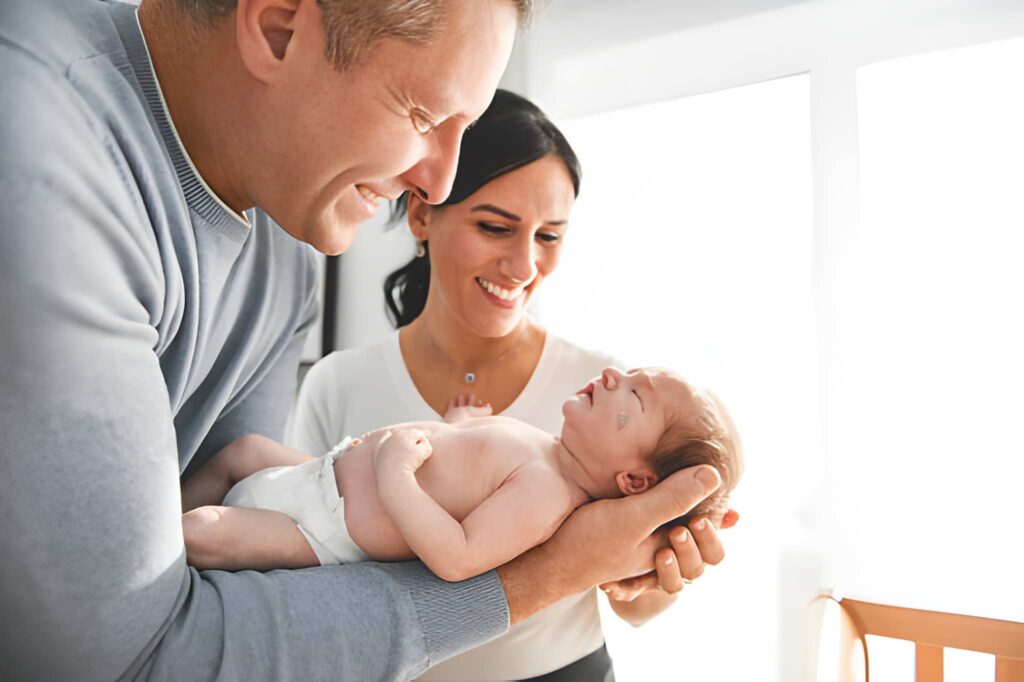
Eye contact is the first form of communication. From a psychological perspective, "mutual gaze" is the foundation of intersubjectivity—the understanding that "I see you, and you see me." This is the earliest form of empathy.
Famous psychological studies show that if a caregiver suddenly adopts a neutral, "still" face and stops returning an infant's gaze, the infant becomes visibly distressed. They will try to "win back" the caregiver with smiles and reaching, eventually withdrawing in despair. This proves how vital visual feedback is for an infant's emotional regulation.
By three to four months, infants begin to follow a caregiver's gaze toward an object. This "joint attention" is a massive psychological leap; it is the beginning of learning about the world through the perspective of another person.
Developmental Milestones in Visual Psychology
The transition from a blurry, gray world to a sharp, colorful one happens with remarkable speed. Below is a breakdown of how visual changes impact psychological behavior.
| Age Range | Visual Capability | Psychological Impact |
|---|---|---|
| 0-1 Month | Peripheral vision focus; high contrast only. | Attachment to the primary caregiver's face. |
| 2-3 Months | Binocular vision begins; color starts to appear. | The "Social Smile" emerges in response to faces. |
| 4-6 Months | Depth perception; full color range. | Intentional reaching and "Object Permanence" awareness. |
| 8-12 Months | Adult-level clarity; tracking fast objects. | Social referencing (looking at parents to see if a stranger is "safe"). |
Optimizing the Visual Environment for Cognitive Health
As a specialist, I often see parents overwhelmed by "educational" toys. The best visual environment for a newborn is surprisingly simple. Because the infant's brain is working so hard to process visual data, "less is often more."
Avoiding Visual Fatigue
An infant who is visually overstimulated will turn their head away, close their eyes, or become fussy. This is a self-regulatory behavior. To support their psychological health, caregivers should provide "rest periods" where visual input is minimized.
- Natural Lighting: Use soft, natural light during the day to help establish circadian rhythms.
- Face-to-Face Time: Spend at least 15 minutes a day in the 10-inch "sweet spot" of focus.
- Dynamic Contrast: Use black and white cards, but move them slowly to encourage "tracking" (the ability of the eyes to follow a moving target).
The Long-Term Impact of Early Visual Engagement
Early visual experiences do not just teach a child "how" to see; they teach them "what" to value. The consistent, loving gaze of a caregiver provides the infant with a sense of existential security. They learn that they are seen, which is the precursor to feeling loved.
While we often focus on the mechanics of eyesight—checking for strabismus (crossed eyes) or cataracts—the psychological dimension is just as critical. A child who is visually engaged with their environment and their caregivers is building the neural pathways for curiosity, empathy, and social intelligence.
In conclusion, a newborn's sight is far more than a physical sense. It is the primary vehicle through which the infant begins to construct their reality. By understanding the limitations and the miraculous "wiring" of the infant eye, we can better support the blooming mind of the child in those first, formative months.