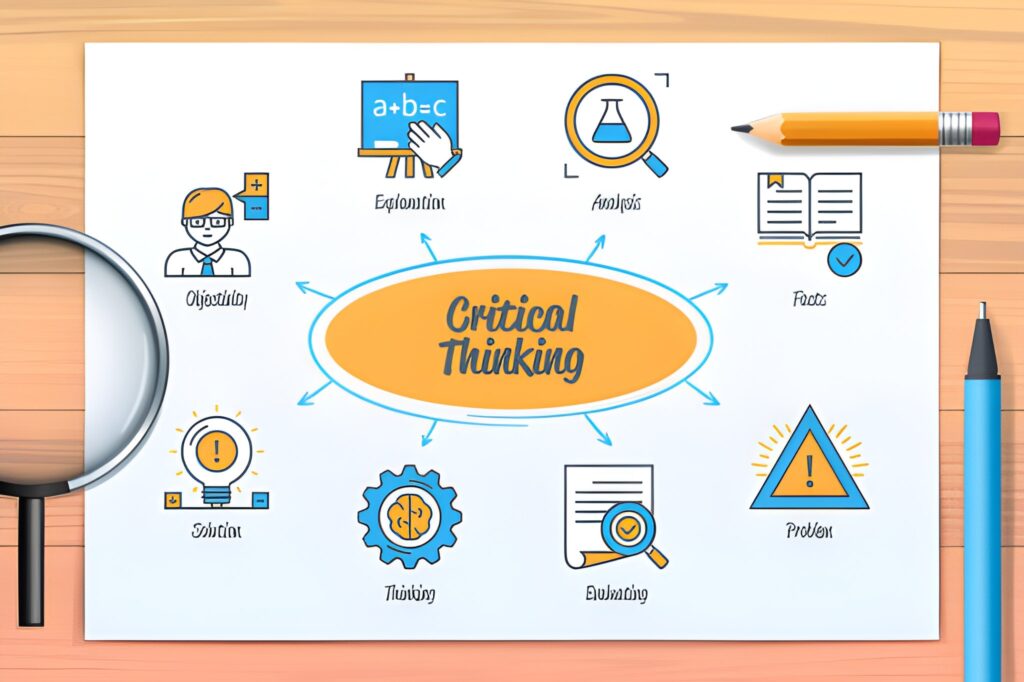
Critical thinking is an essential skill that enables children to analyze information, solve problems, make informed decisions, and think independently. Developing this skill in elementary education lays a foundation for academic success, lifelong learning, and effective decision-making. Teaching critical thinking at a young age requires intentional strategies, engaging activities, and an environment that encourages curiosity, questioning, and reflection. This article explores seven effective ways to teach critical thinking in elementary classrooms, along with practical examples, classroom activities, and assessment strategies.
1. Encourage Questioning and Inquiry
Promoting a culture of questioning helps students develop curiosity and the habit of seeking evidence before forming conclusions.
Strategies:
- Start lessons with open-ended questions that stimulate thinking, e.g., “Why do you think plants need sunlight?”
- Encourage students to ask their own questions about topics being studied
- Use “Think-Pair-Share” activities where students discuss and refine their questions with peers
Classroom Example:
In a science lesson about water cycles, ask students to predict what would happen if it didn’t rain for a month and justify their reasoning.
2. Teach Problem-Solving Techniques
Problem-solving activities help students analyze situations, identify solutions, and evaluate outcomes.
Strategies:
- Present real-world problems related to students’ experiences
- Encourage step-by-step analysis: identify the problem, brainstorm solutions, weigh pros and cons, select the best option
- Use puzzles, math word problems, and logic games to develop structured thinking
Classroom Example:
In a math lesson, present a scenario: “Your class needs to plant a garden. You have 10 square meters and three types of seeds. How will you decide how much to plant of each?”
3. Integrate Discussion and Debate
Structured discussions and debates help students consider multiple perspectives and develop reasoned arguments.
Strategies:
- Use debates on age-appropriate topics like “Should homework be optional?”
- Encourage students to support opinions with facts, reasoning, and examples
- Teach respectful listening and rebuttal skills
Classroom Example:
In a social studies lesson, have students debate the benefits and challenges of recycling in their community.
4. Use Creative and Analytical Writing
Writing activities encourage reflection, organization of ideas, and evaluation of evidence.
Strategies:
- Assign reflective journals where students explain reasoning behind choices
- Encourage persuasive writing that requires supporting arguments with evidence
- Use story prompts to develop alternative endings or analyze characters’ decisions
Classroom Example:
After reading a story, ask students to write a letter to a character suggesting a different solution to a problem they faced.
5. Teach Students to Evaluate Information
In today’s information-rich world, students must learn to assess the reliability and relevance of information.
Strategies:
- Introduce age-appropriate research tasks and guide students to check sources
- Teach students to distinguish between fact and opinion
- Encourage comparison of multiple perspectives before forming conclusions
Classroom Example:
During a history lesson, provide two different accounts of the same event and ask students to identify similarities, differences, and possible biases.
6. Incorporate Hands-On and Project-Based Learning
Projects encourage critical thinking by requiring planning, experimentation, and reflection.
Strategies:
- Assign group projects that involve designing experiments, building models, or solving community problems
- Encourage students to make predictions, test hypotheses, and analyze results
- Include reflection sessions to discuss challenges and lessons learned
Classroom Example:
In a science project, students design a mini-ecosystem and predict how changes in sunlight or water affect plant growth, recording observations and drawing conclusions.
7. Use Games and Puzzles
Games, puzzles, and strategy activities develop analytical thinking and problem-solving in an engaging way.
Strategies:
- Introduce logic puzzles, Sudoku, chess, or strategy board games
- Use classroom games like “Mystery Box” where students guess items using clues and reasoning
- Encourage collaborative problem-solving in teams
Classroom Example:
During math class, play a “Number Detective” game where students solve a series of clues to find a hidden number, explaining each reasoning step.
Table 1: Comparison of Critical Thinking Teaching Strategies
| Strategy | Focus Area | Sample Activity | Skills Developed |
|---|---|---|---|
| Questioning & Inquiry | Curiosity, exploration | Open-ended science questions | Analytical thinking, observation, reasoning |
| Problem-Solving | Decision-making, analysis | Math and real-world scenarios | Logical reasoning, planning |
| Discussion & Debate | Perspective-taking | Classroom debates | Argumentation, communication |
| Creative & Analytical Writing | Reflection, organization | Reflective journals, persuasive essays | Evidence evaluation, reasoning, expression |
| Evaluating Information | Research skills | Comparing multiple sources | Fact-checking, critical assessment |
| Project-Based Learning | Hands-on application | Science experiments, design challenges | Problem-solving, collaboration, reflection |
| Games & Puzzles | Strategy, logic | Logic puzzles, strategy games | Pattern recognition, logical reasoning, teamwork |
Assessment Strategies for Critical Thinking
- Observation: Monitor student participation in discussions and problem-solving tasks
- Rubrics: Evaluate reasoning, evidence use, creativity, and collaboration
- Portfolios: Collect writing assignments, project reports, and reflection journals
- Peer and Self-Assessment: Encourage students to evaluate their own and peers’ thinking processes
Conclusion
Teaching critical thinking in elementary education is essential for preparing students to navigate complex problems, make informed decisions, and develop independent thought. By incorporating questioning, problem-solving, debates, analytical writing, information evaluation, project-based learning, and games, educators can create a stimulating environment that nurtures critical thinking skills. These strategies not only enhance academic performance but also foster lifelong skills such as reasoning, creativity, and effective communication, empowering young learners to succeed both inside and outside the classroom.