Efficiency, Safety, and Strength in Half an Hour
The 30-Minute Prenatal Power Routine: Safe, Full-Body Workouts for Every Trimester
Table of Contents
The 30-Minute Prenatal Philosophy
A successful prenatal workout prioritizes **safety, efficiency, and consistency** over maximal intensity. The body's energy resources are significantly taxed during pregnancy, particularly in the first and third trimesters. A 30-minute routine is optimal: it is long enough to achieve cardiovascular and strength benefits, yet short enough to fit into a busy schedule and prevent overexertion or fatigue.
Core Focus: Pelvic Floor and Posture
Every movement in the prenatal routine serves dual purposes: strengthening the major muscle groups and supporting the core musculature that stabilizes the spine and pelvis. Strengthening the legs and glutes now prepares the body to carry increasing weight and helps prevent common pregnancy-related pain like sciatica and lower back ache.
Clinical Recommendation: Before starting any new exercise routine, ensure you have received **clearance from your OBGYN**. If you were sedentary before pregnancy, begin with 15 minutes of brisk walking and gradually build up to this 30-minute routine at a comfortable, moderate intensity.
The 30-Minute Routine Breakdown
This routine is designed for a full-body workout, segmented into five manageable time blocks. The core of the workout focuses on compound movements and functional strength.
Minutes 0–5: Warm-up and Mobilization
- 3 minutes: Gentle low-impact cardio (marching in place, arm circles, or light cycling).
- 2 minutes: Dynamic stretching (hip circles, shoulder rolls, standing cat-cow).
Minutes 5–20: Strength and Stamina Circuit (3 Rounds)
Perform each exercise for 45 seconds, followed by 15 seconds of rest. Complete the circuit three times.
- Wall Sit or Modified Squats: Focus on maintaining vertical posture. (Modify deepness based on trimester).
- Incline Push-ups: Use a kitchen counter or wall to elevate the hands. Protects the core and avoids lying flat.
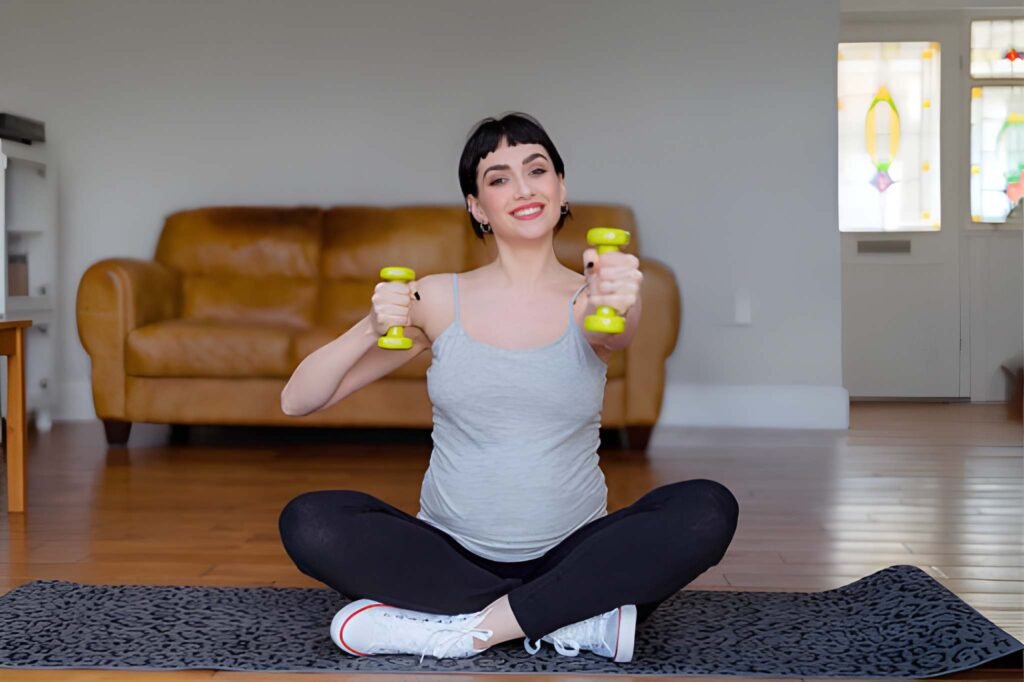
- Standing Overhead Press: Use light dumbbells (2-5 lbs) or resistance bands. Strengthens shoulders and upper back.
- Bird-Dog: On hands and knees, extend opposite arm and leg while keeping the core tight. Excellent for deep transverse abdominis stability.
- Static Lunges: Step forward and back, ensuring the front knee tracks over the ankle. Use a chair for balance if needed (especially Trimester 3).
Minutes 20–25: Core and Pelvic Floor Work
- 2 minutes: Pelvic Tilts (on all fours or standing). Focus on mobilizing the pelvis.
- 1 minute: Pelvic Floor Contractions (Kegels). 10 slow, deep contractions followed by 10 quick pulses.
- 2 minutes: Modified Side Plank (on knees): Hold for 30 seconds per side. Strengthens the obliques safely.
Minutes 25–30: Cool-down and Stretching
- 2 minutes: Lower body static stretch (e.g., standing quad stretch, figure-four stretch against a wall).
- 2 minutes: Deep abdominal breathing (diaphragmatic breathing): Lie on your side (Trimester 2/3) or sit comfortably.
- 1 minute: Hydration and movement goal review.
Exercise Guide and Intensity
The goal is to maintain a moderate intensity throughout the circuit. Use the **Talk Test** as your primary gauge: you should be able to hold a conversation without gasping for air. If breathing is labored, reduce the speed or transition to a static hold.
Focus on Functional Strength
The exercises selected focus on functional movements—motions required for daily activities, labor, and newborn care. Strengthening the upper back (via the Overhead Press) prevents shoulder rounding caused by increased breast size, and strengthening the lower body (Squats/Lunges) is crucial for pushing during delivery and lifting the car seat postpartum.
Proper Hydration: The Hidden Safety Step
Drink water before, during (between circuits), and after the workout. Blood volume increases significantly during pregnancy, and dehydration can lead to overheating and premature contractions. Maintain consistent fluid intake throughout the entire 30 minutes.
Interactive: Trimester Modification Guide
The needs of your body change dramatically every trimester. Click on your current trimester below to see the essential safety modifications for the 30-minute routine.
- Primary Concern: Overwhelming fatigue and nausea.
- Modification: Reduce the circuit to two rounds instead of three. Prioritize rest days. Use the warm-up period to check in with nausea levels; if high, switch to gentle stretching instead of the full circuit.
- Core Rule: All core work is safe, but avoid deep twisting or compression if cramping occurs.
- Primary Concern: Round ligament pain and increased joint laxity (Relaxin).
- Modification: **Avoid lying flat on your back** after Week 16 for any core or cool-down work (use side-lying or all-fours position). Widen your stance on squats and lunges to accommodate the bump and maintain balance.
- Core Rule: Substitute standard planks with Side Planks (on knees) to prevent excessive pressure on the linea alba (midline).
- Primary Concern: Severe breathlessness and center of gravity shift.
- Modification: Reduce intensity to walking or static stretching if necessary. Decrease squat depth. Focus heavily on stability movements (holding onto a chair) and mobility (hip openers) to prepare for labor.
- Core Rule: Stop any exercise that causes "coning" or "doming"—a visible ridge along the center of the abdomen—as this signals excessive internal pressure and potential diastasis recti.
Non-Negotiable Safety Rules
Safety is the defining principle of prenatal fitness. These guidelines supersede any desire to match pre-pregnancy performance levels.
Immediate Stop Signs
If you experience any of the following symptoms during your workout, **stop immediately** and contact your healthcare provider:
- Vaginal bleeding or sudden fluid gush.
- Persistent chest pain or calf swelling/pain.
- Severe dizziness, lightheadedness, or feeling faint.
- Persistent, strong uterine contractions after resting.
Diastasis Recti Check and Core Safety
Diastasis Recti Abdominis (DRA)—the separation of the rectus abdominis muscle—occurs in roughly two-thirds of pregnancies. Protecting the core during the second and third trimesters minimizes this separation.
Avoiding Intra-abdominal Pressure
Avoid high-pressure core exercises that push the abdominal organs forward. These include traditional crunches, full sit-ups, and front planks (after the first trimester). Instead, focus on engaging the transverse abdominis (the deep, stabilizing muscle) through exercises like the Bird-Dog and gentle side planks, which draw the abdominal walls inward and stabilize the torso.
Hydration and Fueling Efficiency
The 30-minute workout demands proper fueling to ensure energy is available for both the exercise and the baby. Maintaining maternal blood sugar levels and hydration status is critical.
Pre- and Post-Workout Fuel
- Pre-Workout (30–60 minutes prior): Consume a small, easily digestible carbohydrate source for immediate energy (e.g., banana, half a bagel).
- Post-Workout (within 30 minutes): Consume a combination of complex carbohydrates and lean protein for recovery and sustained energy (e.g., Greek yogurt and berries, turkey sandwich).
Consistency in both movement and fueling ensures the 30-minute commitment yields maximum return with minimal risk of fatigue or lightheadedness.
Making Consistency the Priority
The true success of the 30-minute prenatal workout lies not in the intensity of a single session, but in the regularity of the habit. Aim for 3 to 5 sessions per week. If a day is dominated by nausea or extreme fatigue (especially Trimester 1), substitute the full circuit with a 15-minute gentle walk or simply the 5-minute cool-down and breathing exercises.
View exercise as medicine—a non-negotiable part of your prenatal care that supports physical endurance for labor, stabilizes mood, and mitigates the risk of gestational diabetes and excessive weight gain. This half-hour investment supports not only your health today but your recovery tomorrow.