Radical Change, Righteous Science
Home Pregnancy Tests of the 1980s: Technology and Culture
Table of Contents
The Analog Revolution: From Lab to Living Room
The 1980s marked the peak of the home pregnancy testing revolution, which began with the introduction of the first over-the-counter test in the late 1970s (e.g., e.p.t.—"early pregnancy test"). Before this, a woman had to wait weeks for a missed period, schedule a doctor's visit, and wait days for lab results, often involving complex tests using animal specimens.
The 80s solidified the home test as a consumer product, though the experience was far removed from today's quick, digital convenience. The tests were complex, involved multiple steps, and required a significant amount of time and dedicated space. This shift drastically empowered women, giving them immediate, private information that fundamentally altered the relationship between patient and physician in early pregnancy.
The Technology of the 80s: Hemagglutination Inhibition
The dominant technology of early 1980s home pregnancy tests relied on an immunological process known as Hemagglutination Inhibition. This method was a simplified version of the laboratory tests previously used and required the user to perform a complex, multi-step chemical reaction.
The 3-Step Hemagglutination Process
This test typically came in a kit that included a vial, a medicine dropper, and small amounts of chemicals, often performed in a dedicated mixing tray:
- Step 1: Urine Collection. First morning urine (FMU) was crucial for concentration.
- Step 2: Mixing. The urine was mixed with a solution containing an antibody sensitive to Human Chorionic Gonadotropin (hCG) and sheep red blood cells coated with hCG.
- Step 3: The Wait and Result. The mixture was placed in a specialized test tube or ring and left undisturbed, often for 90 minutes to 2 hours.
Popular Tests and The EPT Experience
The brand e.p.t. (Early Pregnancy Test) dominated the market in the early 80s. Their marketing focused heavily on privacy and speed relative to the old lab methods, emphasizing the two-hour wait time as revolutionary.
Later in the decade, competing brands like Clearblue and First Response began to emerge, often capitalizing on slightly improved technology that reduced the necessary waiting time or provided clearer results, slowly nudging the industry toward the simpler, stick-based tests that would define the 1990s. The test cost was substantial, often priced around 10 to 20 in 1980s currency, equivalent to nearly 30 to 60 today, making early testing a considerable investment.
Accuracy, Timing, and the 2-Hour Wait
Accuracy in the 1980s was highly dependent on user adherence to the complex instructions, the concentration of hCG in the sample, and the inherent sensitivity limitations of the technology.
Detection Threshold and Accuracy
The tests of the early 80s were less sensitive than modern tests, typically requiring an hCG level of 1000 to 2000 mIU/mL to reliably register a positive result.
- Modern Standard: Today's sensitive tests detect hCG as low as 6.3 mIU/mL to 25 mIU/mL.
- Accuracy: While claimed to be over 90 percent accurate, this was often only true if the test was taken a full week after the missed period (Weeks 5-6 gestation), when hormone levels were extremely high. Testing earlier frequently resulted in false negatives.
The Late 80s Shift: Monoclonal Antibodies Arrive
The technology shifted significantly around 1987-1988 with the introduction of monoclonal antibody technology. This represented the biggest change in home pregnancy tests since their inception.
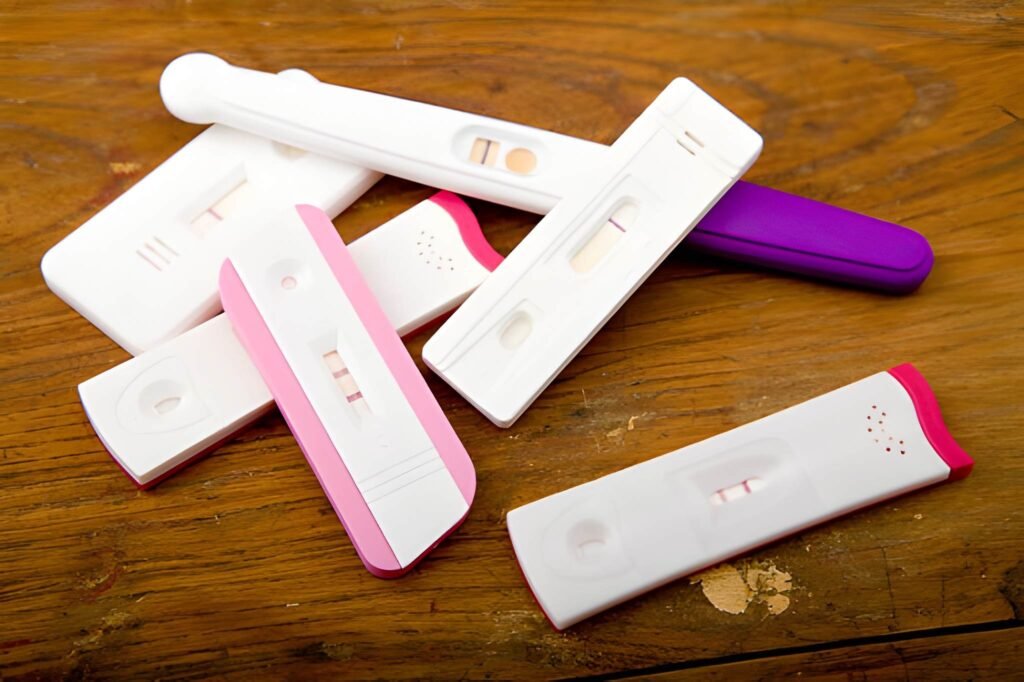
Monoclonal antibodies allowed for the development of the simpler, rapid, single-step lateral flow tests—the foundation of the test sticks and strips used today. These tests reduced the detection time from hours to minutes, lowered the detection threshold to 50 mIU/mL or less, and produced a clear, visually distinct line (or plus sign), eliminating the need for complex chemical mixing and pattern interpretation. This technological improvement set the stage for the hyper-sensitive, digital, and week-estimating tests that dominate the market today.
Cultural and Socioeconomic Impact
The 80s home pregnancy test had a significant socioeconomic and cultural impact, largely rooted in the US context of limited reproductive healthcare access and job insecurity.
- Privacy and Control: It gave women control over the timing of this life-altering news, allowing them to process the information, plan their next steps (be they prenatal care or termination), and inform their partner or employer on their own terms.
- Financial Planning: By providing earlier confirmation, the test enabled families to engage sooner in crucial financial planning, including reviewing health insurance coverage for prenatal care, which became increasingly important in the high-deductible healthcare landscape of the late 80s.
- Doctor Relationship: It changed the conversation with the doctor. Patients arrived with confirmation in hand, shifting the focus of the first visit from diagnosis to immediate planning and risk assessment.
Conclusion: The Foundation of Modern Testing
The pregnancy test of the 1980s was an analogue, chemical curiosity—a multi-step experiment involving test tubes, powder, and a long wait—but its introduction into the home marked a seismic shift in reproductive autonomy. While accuracy was low and the process cumbersome by modern standards, the shift toward rapid, private access to information defined the decade. The subsequent adoption of monoclonal antibody technology in the late 80s paved the way for the high-sensitivity, quick-read stick tests that consumers rely on today, making the 1980s a true transitional era in fertility technology.