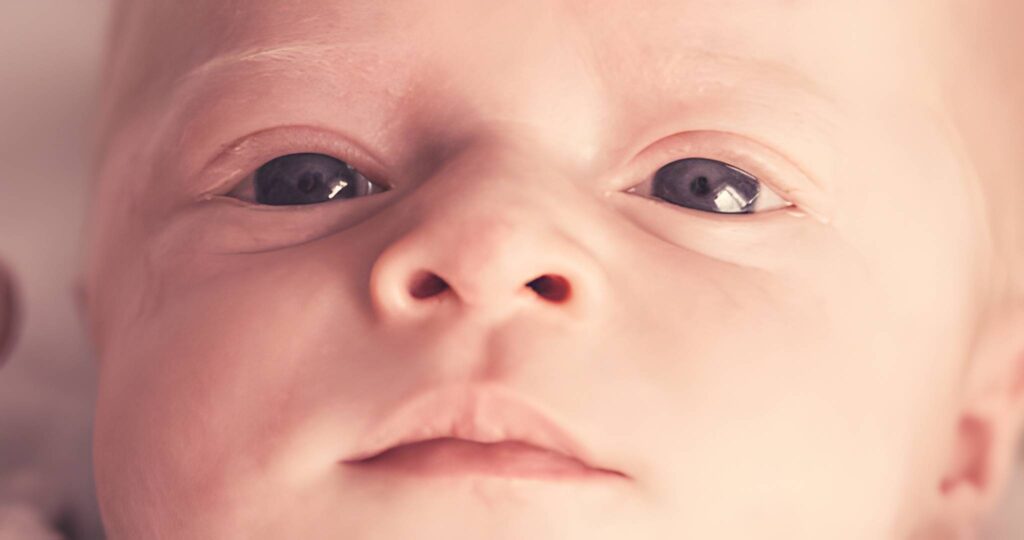
Beyond the Blur: The Psychological Journey of Newborn Vision
Debunking myths and exploring the evolution of how infants see the world
A common misconception persists in early parenting circles: the idea that a newborn’s vision is completely developed at birth. From a psychological and physiological standpoint, nothing could be further from the truth. While an infant enters the world with the basic physical hardware—eyes, retinas, and a visual cortex—the software required to process and interpret visual data is significantly underdeveloped. A newborn does not "see" the world in high-definition; instead, they experience a soft, high-contrast, and extremely localized visual field.
As a specialist in child development, I often describe the first few months of life as a "visual apprenticeship." The brain must learn how to coordinate the eyes, how to focus at varying distances, and how to interpret the complex shapes that form a human face. This process is not just a biological milestone; it is a critical component of psychological attachment and cognitive growth.
Article Navigation
1. The Blur of Infancy: Understanding Visual Acuity 2. Black, White, and Gray: The Color Perception Timeline 3. The Psychology of Faces: Why Babies Stare at You 4. Depth and Motion: Learning the Third Dimension 5. Supporting Visual Growth: Environment and Interaction 6. Common Questions for CaregiversThe Blur of Infancy: Understanding Visual Acuity
When we discuss visual acuity, we refer to the sharpness or clarity of vision. In adults, "normal" vision is classified as 20/20. For a newborn, that number is closer to 20/400 or even 20/600. To put this in perspective, if an adult had the vision of a newborn, they would be considered legally blind in many jurisdictions.
This limitation occurs because the fovea—the part of the retina responsible for central, sharp vision—is not yet fully packed with light-sensitive cones. Additionally, the muscles controlling the lens of the eye are weak, making it difficult for the infant to "accommodate" or change focus between near and far objects.
Black, White, and Gray: The Color Perception Timeline
The world of a newborn is largely a monochromatic one. While the eyes have the physical capacity to detect color, the brain’s ability to distinguish between subtle shades is not yet functional. This is why newborns are intensely attracted to high-contrast patterns.
| Age Range | Color Perception Capabilities | Psychological Preference |
|---|---|---|
| Birth – 4 Weeks | Black, white, and high-contrast gray | Bold patterns, stripes, and checkerboards |
| 2 Months | Primary colors begin to emerge (Red first) | Bright, saturated toys and blocks |
| 4 Months | Full spectrum of color becomes visible | Subtle shades and pastels |
| 6 Months | Acuity and color reach near-adult levels | Complex visual scenes and distant objects |
Psychological studies have shown that infants will spend significantly more time staring at a black-and-white bullseye than a solid red or yellow disc. This preference for contrast helps "train" the visual cortex, providing the sharp edges the brain needs to start mapping the physical world.
The Psychology of Faces: Why Babies Stare at You
Perhaps the most fascinating aspect of neonatal psychology is the "face bias." Even with their blurry vision, newborns show an immediate and profound preference for face-like stimuli. If you show a one-day-old infant a drawing with three dots arranged like eyes and a mouth, and another drawing with the dots scrambled, they will consistently track the face-like pattern.
This is an evolutionary survival mechanism. By focusing on faces, the infant ensures they are attending to their primary source of food, protection, and social interaction. By the end of the first month, an infant can often distinguish their mother's face from a stranger's, provided the mother is within that 8-to-12 inch focus range.
Newborns seek out eyes because they are the highest-contrast part of the human face. This eye-to-eye contact triggers the release of oxytocin in both the baby and the parent.
A newborn can track a slow-moving object (like a face) horizontally. Vertical tracking and smoother "pursuit" movements develop over the first three months.
Depth and Motion: Learning the Third Dimension
Stereopsis, or binocular vision, is the ability of the brain to combine images from both eyes into a single, three-dimensional view. At birth, a newborn’s eyes often move independently or "wander." It isn't until the eyes begin to work in tandem (usually around month three) that depth perception truly begins to develop.
This development is tied closely to motor skills. As a baby begins to reach for objects, their brain receives "feedback" on distance. If they reach and miss, the brain recalibrates. This hand-eye coordination is a feedback loop that accelerates visual maturity.
Supporting Visual Growth: Environment and Interaction
Because vision is so "plastic" in the early months, the environment plays a major role. In the year , we are increasingly concerned about "screen time" for infants. The blue light and flat, 2D nature of screens provide poor stimulus for a brain that is trying to learn how to focus in a 3D world.
Effective Ways to Encourage Development
Use High-Contrast Assets: Decorate the nursery or provide board books with bold black-and-white illustrations. These provide the most "signal" for the infant’s "noise-heavy" visual system.
Vary the Lighting: While newborns are sensitive to very bright light, dim or natural light helps them learn to adjust their pupils. Avoid keeping the infant in a darkened room all day.
Change Sides: When feeding or holding the infant, alternate sides. This encourages them to use both eyes equally and track movement from both directions, preventing the development of a "preferred" eye or side.
Common Questions for Caregivers
Navigating the first few months can be overwhelming. Here are some of the most frequent concerns I address in my practice regarding neonatal vision.
Yes, absolutely. In the first two months, it is very common for an infant’s eyes to appear crossed or to wander outward. The muscles that coordinate eye movement are still strengthening. However, if this persists after four months, it is worth consulting a pediatric ophthalmologist.
Most babies are born with blue or gray eyes. The pigment (melanin) in the iris takes time to develop when exposed to light. You will likely see the "final" color by six to nine months, though minor shifts can happen up until the second or third year.
Newborns are attracted to high contrast. The line where your dark hair meets your forehead is a very sharp edge that is easy for their blurry vision to lock onto. As their acuity improves, they will shift their focus downward to your eyes and mouth.
Understanding that your newborn's vision is a work in progress allows you to appreciate the small victories—the first time they track a toy, the first time they smile at your face from across the room, and the moment they finally see the vibrant colors of their world. Vision is not just about seeing; it is about connecting. By respecting the pace of this development, we help our children build a solid foundation for a lifetime of discovery.