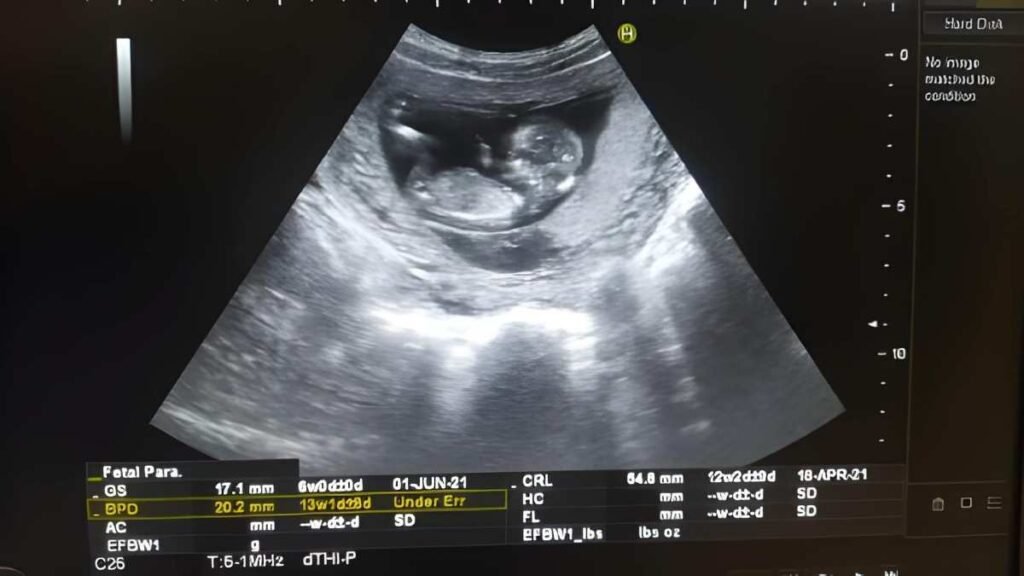
The 5.5 Week Scan: Confirming Viability and Early Structure
The 5.5-week mark of gestation is a moment of intense anticipation, often following the first confirmation of pregnancy via a home test. This early ultrasound, usually conducted between weeks 5 and 6, is not routinely standard for all pregnancies but is frequently performed for clinical certainty. The primary purpose is not growth assessment, but three non-negotiable checks: confirming the precise location of the pregnancy, measuring its earliest structures for accurate dating, and assessing viability by searching for the first rhythmic flutter of the heart.
As a specialist in child and mother health, I confirm that the technology used at this stage requires precision. Understanding the microscopic visual markers sought by the sonographer alleviates the anxiety inherent in this early waiting period, clarifying what is normal and what warrants follow-up.
Table of Contents
1. The Procedure: Transvaginal Ultrasound (TVS)
At 5.5 weeks, the embryo and surrounding structures are extremely small. To achieve the necessary high-resolution images, the scan is almost always performed using a **Transvaginal Ultrasound (TVS)**, rather than the transabdominal approach used later in pregnancy.
Transvaginal Technique and Preparation
The TVS uses a thin, sterile probe inserted into the vaginal canal. Because the probe is physically closer to the uterus, it utilizes higher frequency sound waves that provide superior clarity of the pelvic organs and the developing gestational sac. Unlike later transabdominal scans, the bladder should usually be empty for a TVS to minimize interference.
Fetal Size: The Grain of Rice Analogy
At 5.5 weeks, the embryo itself is only about 1.5 to 3 millimeters long, approximately the size of a grain of rice. Given this tiny size, the success of the scan relies entirely on precisely identifying the structures immediately adjacent to the embryo.
2. Primary Clinical Goals: Location and Viability
The urgency of the 5.5-week scan is driven by the need to confirm that the pregnancy is developing in the correct, safe location, and to gather the first definitive data on its health status.
Goal 1: Confirming IUP (Intrauterine Pregnancy)
The highest priority is to rule out an **Ectopic Pregnancy**, a life-threatening condition where the embryo implants outside the uterus, usually in the fallopian tube. The scan confirms the presence of the gestational sac within the main uterine cavity. If the gestational sac is not visible, blood work (Quantitative hCG) must be correlated with the scan findings to rule out an ectopic pregnancy definitively.
Goal 2: Establishing Viability and Accurate Dating
Although the due date is initially calculated using the first day of the Last Menstrual Period (LMP), early ultrasound measurement provides the most accurate clinical dating. This measurement, particularly the **Crown-Rump Length (CRL)** if the embryo is visible, is accurate to within a few days at this early stage. This precise dating is foundational for scheduling all subsequent prenatal tests.
3. The Visual Milestones at 5.5 Weeks
The sonographer looks for three key structures that appear in rapid succession during the fifth and sixth weeks. These are the visual proof of a developing intrauterine pregnancy (IUP).
The Three Visual Proofs of Early Pregnancy
The GS is a fluid-filled sac surrounding the embryo. It is the first sign of pregnancy visible on TVS, typically appearing around 5 weeks. At 5.5 weeks, the GS should measure approximately 8–10 millimeters.
Appearing inside the GS around 5.5 weeks, the YS is a small, ring-like structure that provides essential nourishment and blood production until the placenta fully matures. Visualization of the YS confirms development is proceeding correctly.
The FP is the thickening immediately adjacent to the yolk sac. It represents the earliest visual sign of the developing embryo. At 5.5 weeks, the FP may or may not be clearly visible, but it should definitely be present by the time the GS reaches 25 millimeters.
4. The Crucial Question: Detecting the Heartbeat
One of the main reasons for seeking a 5.5-week scan is the hope of hearing or seeing the heartbeat. While the primitive heart tube begins beating around 5 to 6 weeks, its detection at 5.5 weeks is highly dependent on imaging clarity and the precise day of development.
Heartbeat Detection Window
The fetal heart is one of the first organs to function, but it is microscopically small. Detection is typically possible when the **Crown-Rump Length (CRL)** reaches 2-3 millimeters, which occurs around 5.5 weeks. However, the absence of a visible heartbeat at 5.5 weeks is **not necessarily a sign of a problem**, provided the Gestational Sac and Yolk Sac measurements are appropriate. A clear heart rate is nearly always guaranteed by 6.5 weeks.
| Gestational Age | Expected Findings |
|---|---|
| 5 Weeks 0 Days | Gestational Sac (GS) visible. |
| 5 Weeks 3 Days | Yolk Sac (YS) typically visible inside GS. |
| 5 Weeks 5 Days | Fetal Pole (FP) usually present. Heartbeat may be detectable. |
| 6 Weeks 5 Days | Heartbeat (Fetal Cardiac Activity) definitively expected. |
5. Interpreting Atypical Findings and Next Steps
If the scan findings are not definitively reassuring, the clinical approach is almost always to wait and rescan, allowing the rapid pace of early fetal development to confirm viability.
Common Atypical Findings and Follow-Up
- Empty Gestational Sac (Blighted Ovum Risk): If the GS is visible but the Yolk Sac or Fetal Pole is absent, and the GS measurement is large enough (often > 25 mm), it may indicate a blighted ovum. However, if the GS is small (e.g., 10 mm), the provider will simply schedule a repeat scan in one week.
- No Detectable Heartbeat (Uncertainty): If a Fetal Pole is visible but no heartbeat is detected, a repeat TVS scan in 5 to 7 days is mandatory. The rapid rise of hCG and development should resolve the uncertainty quickly.
- Low or Slow-Rising HCG: If the scan is inconclusive (no IUP visible) and blood work shows low or slow-rising hCG, the provider will intensify monitoring due to the risk of an impending miscarriage or an ectopic pregnancy.
The 5.5-week ultrasound is a scan defined by precision and prudence. While the wait for the clear heartbeat can be difficult, the ability to confirm the intrauterine location and track the foundational structures provides essential confidence. Approach this early appointment with the knowledge that the smallest images hold the largest diagnostic value, setting the trajectory for the remainder of your pregnancy care.