Early childhood is a period of rapid growth, where children develop cognitive, social, emotional, and physical skills that form the foundation for lifelong learning. Understanding how children learn is as important as what they learn. The Early Years Learning Framework (EYLF) and other international early childhood frameworks identify eight key ways in which young children explore, engage, and make sense of the world around them. Recognizing and fostering these ways of learning helps educators, caregivers, and parents create rich, stimulating environments that support curiosity, resilience, creativity, and problem-solving.
1. Play-Based Learning
Play is central to early childhood learning. Through play, children experiment with ideas, negotiate rules, develop social skills, and explore emotions. Play-based learning is active, child-centered, and intrinsically motivating.
- Key Components:
- Imaginative play: Role-playing, storytelling, and pretend scenarios.
- Constructive play: Building with blocks, creating art, or assembling puzzles.
- Social play: Cooperative games, sharing, and turn-taking.
- Example in Practice: A “pretend supermarket” allows children to assign roles, manage transactions, and practice communication, social interaction, and numeracy skills.
- Table: Play Types and Learning Outcomes
| Type of Play | Skills Developed | Example Activity |
|---|---|---|
| Imaginative Play | Creativity, problem-solving, empathy | Role-playing a doctor or teacher |
| Constructive Play | Spatial awareness, fine motor skills | Building block towers |
| Social Play | Cooperation, negotiation | Group games with rules |
2. Inquiry-Based Learning
Inquiry-based learning encourages children to ask questions, explore, and seek answers actively. It fosters curiosity, critical thinking, and problem-solving.
- Key Components:
- Observation: Noticing patterns, changes, and details in the environment.
- Questioning: Asking “why” and “how” questions to investigate phenomena.
- Experimentation: Testing ideas and drawing conclusions through trial and error.
- Example in Practice: In a water play activity, children hypothesize which objects float or sink, test their ideas, and discuss results, integrating science, mathematics, and language skills.
3. Experiential Learning
Children learn effectively when they experience concepts firsthand. Experiential learning connects theory to real-world applications.
- Key Components:
- Hands-on activities: Engaging all senses in exploration.
- Real-life context: Learning in authentic settings such as kitchens, gardens, or community spaces.
- Reflection: Encouraging children to discuss and reflect on experiences.
- Example in Practice: Cooking activities allow children to measure ingredients, follow sequences, observe chemical changes (e.g., baking), and practice teamwork.
4. Active Learning
Active learning involves engagement, movement, and exploration. Children retain knowledge better when they participate actively rather than passively receiving information.
- Key Components:
- Movement-based learning: Using gross and fine motor skills to reinforce concepts.
- Decision-making: Children make choices, plan activities, and solve problems.
- Investigation: Exploring materials, objects, and concepts actively.
- Example in Practice: Outdoor scavenger hunts encourage children to move, observe, compare, and collect items, integrating physical activity with cognitive and observational skills.
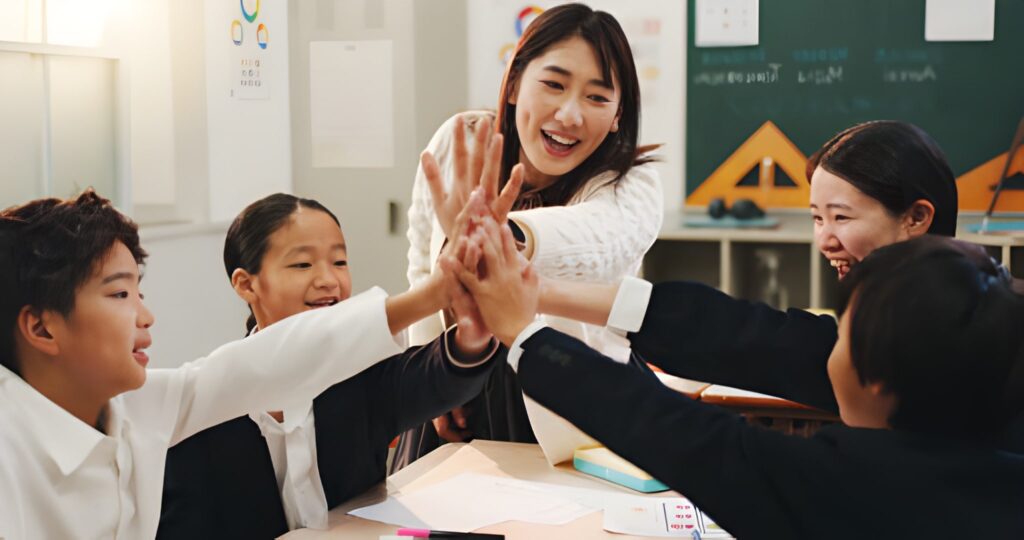
5. Collaborative Learning
Learning alongside peers fosters social skills, empathy, and teamwork. Collaborative learning allows children to share knowledge, negotiate roles, and learn from each other.
- Key Components:
- Group projects: Shared tasks with common goals.
- Peer discussion: Sharing ideas and strategies.
- Role negotiation: Taking turns, cooperating, and resolving conflicts.
- Example in Practice: A classroom gardening project encourages children to assign tasks, share tools, and collaboratively plan plant placement, integrating social, physical, and cognitive learning.
6. Reflective Learning
Reflection helps children think about their experiences, evaluate outcomes, and make adjustments. Reflective learning strengthens metacognition and self-awareness.
- Key Components:
- Thinking aloud: Encouraging children to articulate what they did and why.
- Journaling or drawing: Recording observations and ideas visually.
- Discussion: Guided conversations about learning experiences.
- Example in Practice: After completing a building challenge with blocks, children discuss what worked, what didn’t, and how they can improve next time.
7. Sensory Learning
Sensory experiences engage multiple senses and support cognitive, language, and motor development. Sensory learning helps children make sense of their environment and enhances memory and understanding.
- Key Components:
- Tactile: Touching different textures, materials, and objects.
- Auditory: Listening to sounds, music, and environmental noises.
- Visual and olfactory: Observing colors, shapes, patterns, and smells.
- Example in Practice: A sand and water table allows children to explore textures, measure volumes, and observe cause-and-effect relationships, stimulating sensory and cognitive development.
8. Problem-Solving and Critical Thinking
Early problem-solving lays the foundation for logical reasoning, creativity, and adaptive thinking. Children develop confidence and independence through challenges.
- Key Components:
- Identifying challenges: Recognizing obstacles in tasks or activities.
- Strategizing: Planning steps and testing solutions.
- Evaluating outcomes: Reflecting on success and learning from mistakes.
- Example in Practice: Children are given materials to build a bridge that can hold a toy car. They experiment with shapes, weight distribution, and balance, integrating mathematics, physics, and creativity.
- Comparison Table: Ways of Learning and Core Skills Developed
| Way of Learning | Skills Developed | Example Activity |
|---|---|---|
| Play-Based Learning | Creativity, social skills, problem-solving | Pretend supermarket |
| Inquiry-Based Learning | Curiosity, critical thinking, exploration | Water play “float or sink” experiment |
| Experiential Learning | Real-world application, teamwork | Cooking or planting activities |
| Active Learning | Physical coordination, engagement | Scavenger hunt |
| Collaborative Learning | Social competence, communication | Group gardening project |
| Reflective Learning | Self-awareness, metacognition | Post-activity discussion |
| Sensory Learning | Cognitive, motor, perceptual development | Sand and water table |
| Problem-Solving/Critical Thinking | Logical reasoning, creativity | Building a bridge challenge |
Integration in Practice
An early childhood classroom that incorporates the eight ways of learning creates a dynamic environment. For example, a project on community helpers can include:
- Play-based learning: Pretend role-play as doctors, firefighters, and teachers.
- Inquiry-based learning: Asking questions about the roles and responsibilities of each helper.
- Experiential learning: Visits to a local fire station.
- Active learning: Setting up obstacle courses simulating emergency responses.
- Collaborative learning: Group tasks such as building a miniature town model.
- Reflective learning: Discussions about what was learned and felt during activities.
- Sensory learning: Using materials like clay, uniforms, or sounds of sirens.
- Problem-solving: Planning a community safety scenario and resolving challenges in role-play.
Conclusion
The eight ways of learning in early childhood provide a holistic framework that guides educators and caregivers in nurturing curiosity, resilience, creativity, and critical thinking. Integrating play, inquiry, experience, active participation, collaboration, reflection, sensory engagement, and problem-solving into daily routines ensures that children develop the skills, confidence, and independence needed for lifelong learning. Recognizing and supporting these diverse learning pathways allows children to explore the world meaningfully, forming the foundation for academic success and personal growth.