The Silent Dialogue
Understanding Newborn Eye Widening and Social Engagement in
Article Chapters
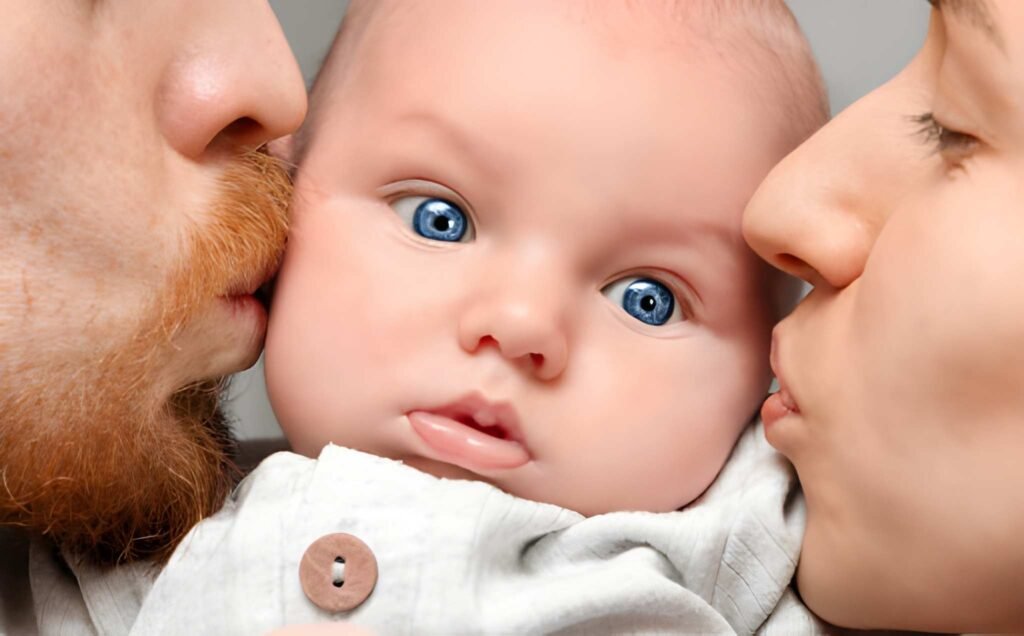
Few experiences match the intensity of the moment a newborn baby widens her eyes and locks her gaze onto her mother. This interaction represents far more than a simple reflex; it signifies the birth of social communication and the activation of complex neural pathways. For the infant, the mother’s face serves as the primary map for navigating the world, providing the essential data needed for emotional regulation and social learning.
In the quiet alertness of the neonatal period, these visual exchanges act as the foundation for the "social brain." While the infant’s physical movements remain uncoordinated and her vocalizations limited to cries, her eyes function as a sophisticated tool for engagement. Understanding why she widens her eyes and how she processes her mother’s features reveals the extraordinary biological readiness for human connection that exists from the very first hour of life.
The First Visual Connection
Infants arrive in the world with a biological preference for human faces over any other visual stimuli. Research in developmental psychology indicates that even minutes after birth, a newborn will track a face-like pattern more consistently than a scrambled image of the same complexity. This innate bias ensures that the infant focuses on the caregiver—the most critical source of safety, nourishment, and information.
When a mother speaks, smiles, or moves into the infant’s field of vision, the baby often enters a state of quiet alertness. Her breathing may slow, her body movements may still, and her eyes will widen. This physiological "pause" allows the infant to dedicate all available neural energy to processing the mother’s facial expressions and tone of voice.
How a Newborn Actually Sees
At birth, the visual system is the least developed of the senses. The retinas are not yet fully sensitive to color, and the muscles controlling eye focus are weak. Consequently, the infant’s world consists of soft edges and high-contrast patterns. Understanding these limitations helps parents realize why certain interactions trigger the "eye-widening" response more effectively than others.
Contrast vs. Color
Newborns see primarily in shades of gray, black, and white. Bold patterns and the high contrast of a mother’s hairline against her skin or the dark of her pupils against the white of her eyes are what grab a baby's attention.
Fixed Focus
Unlike an adult who can shift focus from a hand to a distant wall, a newborn’s focus is relatively fixed at that 8–12 inch range. Anything further away appears as a blurry, indistinct shape.
This "near-sightedness" by design serves a protective purpose. It prevents the infant from being overwhelmed by the vast, chaotic environment of a room, forcing her to concentrate exclusively on her mother. When she widens her eyes, she is maximizing the amount of light and information hitting her retinas, attempting to resolve the blurry image of the person most important to her.
The 'O-Face' and Eye Widening
One of the most recognizable expressions in infancy is the "O-face"—a combination of widened eyes and an oval-shaped mouth. This expression often occurs when the infant is surprised, intrigued, or deeply engaged with her mother. Clinically, this is viewed as a sign of high sensory arousal.
When a mother moves her face close to the baby or uses a high-pitched, melodic voice (often called "motherese" or "parentese"), the infant’s autonomic nervous system reacts. The widening of the eyes is a physical manifestation of her curiosity. It is her way of saying, "I am paying attention; give me more information." This response is a precursor to the social smile and represents the first step in the infant’s ability to participate in a two-way dialogue.
The Engagement Loop
Mother smiles -> Baby widens eyes -> Mother reacts with joy -> Baby stays alert.
Mirror Neurons and Mimicry
Why does a baby often try to copy her mother’s expressions? The answer lies in mirror neurons. These are specialized brain cells that fire both when an individual performs an action and when they observe someone else performing that same action. When a mother widens her eyes or sticks out her tongue, the infant’s brain "practices" that same movement internally.
This mimicry is the earliest form of empathy. By mirroring her mother’s facial states, the infant begins to "feel" what the mother is expressing. If the mother looks surprised and wide-eyed, the infant’s brain simulates that state. This biological echoing is how infants begin to categorize emotions long before they have the language to name them. When she widens her eyes after her mother, she is literally trying to "be" like her caregiver to understand her.
The Serve and Return Concept
The Center on the Developing Child at Harvard University uses the metaphor of a tennis match—serve and return—to describe the interaction between a child and a caregiver. When the baby widens her eyes, babbles, or gestures, she is "serving" an invitation to interact. When the mother "returns" the serve by making eye contact, smiling, or speaking back, the neural connections in the baby's brain are strengthened.
The eye-widening response is often the very first "serve" an infant provides. It is an invitation for the mother to lean in. When the mother responds with a similar expression of wonder, she validates the infant’s curiosity and signals that the world is a responsive and safe place.
A Timeline of Visual Discovery
While the eye-widening and intense staring begin at birth, the complexity of the interaction evolves rapidly over the first twelve months. Parents can track these milestones to see how their daughter’s visual and social world is expanding.
Infants spend much of their time in "obligatory looking," where they may find it difficult to turn their gaze away from a high-contrast object or a face. Eye widening is a primary response to a parent’s voice or face.
The "social smile" emerges. The infant no longer just stares; she reacts with a smile that involves her whole face, including crinkling at the eyes. She begins to track moving objects with more fluidity.
Color vision is nearly full-strength. The infant begins to recognize familiar faces from across a room. Eye widening may now be accompanied by excited limb movements and squeals of delight.
The baby begins to look where you look (joint attention). If you point at a dog and widen your eyes, she will look at the dog and then back at you to share the experience. This is a massive leap in social intelligence.
Nurturing the Bond Through Sight
Parents can actively support this neurological "dialogue" by being intentional about their visual presence. Since the newborn brain is highly sensitive to facial data, providing "quality face time" is one of the most effective ways to promote development.
When you notice your daughter widening her eyes, lean in. Maintain eye contact for a few seconds longer than you might with an adult. Use exaggerated facial expressions—a wide smile, raised eyebrows, or a look of mock surprise. These "high-octane" expressions are easier for her developing brain to decode. Remember that her "O-face" is her way of learning your soul; give her the time to finish her "visual meal" before turning her away or introducing a toy.
Finally, respect her need for "down-time." The same eye-widening that signals engagement can eventually lead to overstimulation. If she turns her head away, arches her back, or begins to fuss after an intense period of eye contact, she is signaling that her brain has reached its limit for processing information. By responding to her "serves" and respecting her "breaks," you build a foundation of trust that will last a lifetime.
The moment she widens her eyes after her mother is a silent promise. It is the beginning of a billion neural connections and a lifelong conversation. By paying attention to these small, visual cues, we participate in the most profound dance of human biology—the creation of a bond through the simple act of seeing and being seen.