The 14 DPO Positive: Understanding Your Pregnancy Confirmation
A Specialist's Guide to the Significance, Science, and Next Steps
Table of Contents
What Exactly is 14 DPO?
The abbreviation 14 DPO stands for "14 Days Past Ovulation." For a person with a textbook 28-day menstrual cycle, $14$ DPO coincides precisely with the day their period is expected to arrive. It marks the conclusion of the luteal phase, the second half of the cycle, where the body prepares the uterine lining either for implantation or menstruation.
If fertilization successfully occurred and the resulting embryo implanted, the body initiates a profound hormonal cascade. This process involves the sustained production of progesterone by the corpus luteum and, critically, the introduction of a new hormone: Human Chorionic Gonadotropin (hCG). Because 14 DPO allows this hormone sufficient time to build up in the bloodstream and urine, it serves as the benchmark for a highly reliable, non-missed-period pregnancy test. Receiving a positive result at this exact moment shifts the cyclical narrative from waiting and uncertainty to confirmed early pregnancy.
Fact Check: The Reliability of 14 DPO
At 14 DPO, most sensitive at-home pregnancy tests offer an accuracy rate exceeding 99% if used correctly. Testing earlier carries a higher risk of a false negative because hCG levels may not yet meet the test's detection threshold. Waiting until $14$ DPO minimizes ambiguity.
The Science of hCG: Why You Test Positive
A positive pregnancy test, whether faint or undeniably dark, depends entirely on the detection of Human Chorionic Gonadotropin (hCG). This complex glycoprotein hormone is often referred to as "the pregnancy hormone" for a clear reason: its presence indicates a developing pregnancy.
The production of hCG begins immediately after the blastocyst, the early embryo, successfully implants itself into the uterine wall. The outer layer of the blastocyst, known as the trophoblast cells (which eventually form the placenta), initiates the rapid release of hCG into the mother's system. The hormone’s primary job in the first trimester is to signal the corpus luteum—the remnant of the ovarian follicle that released the egg—to continue producing progesterone. Progesterone is the vital hormone responsible for maintaining the thick, nutrient-rich uterine lining, thereby supporting the early stages of the developing fetus.
HPTs measure the concentration of this hormone in urine. Most standard over-the-counter tests require an hCG concentration of at least $25$ milli-international units per milliliter (mIU/mL) to register a positive result. Given the rapid doubling rate of hCG, $14$ DPO is the moment when these levels generally cross the detection threshold for a large majority of pregnancies.
Expected hCG Levels at 14 DPO
The rate at which hCG rises is a vital indicator of a viable, progressing pregnancy. After implantation, hCG levels typically double every $48$ to $72$ hours. By $14$ DPO, the range of normal hCG levels is wide, reflecting the variability in implantation timing and individual biology. While a single number is less important than the trend over time (a physician often orders two blood draws, or "betas," two days apart to check the doubling time), understanding the general range provides context.
One major study found the median serum hCG level at $14$ DPO to be approximately $137$ mIU/mL. The ranges are extensive, often cited from as low as $10$ mIU/mL up to $426$ mIU/mL or higher. A positive home test confirms your levels have reached at least the $25$ mIU/mL mark, confirming the presence of the hormone.
A Comparison of Early hCG Levels
| Days Past Ovulation (DPO) | Median hCG Level (mIU/mL) | Testing Reliability |
|---|---|---|
| 10 DPO | 12 | Low, high chance of false negative |
| 12 DPO | 48 | Moderate, early detection possible |
| 14 DPO | 137 | High, definitive result expected |
| 16 DPO | 315 | Very High, confirms doubling time |
This median data underscores why $14$ DPO is the sweet spot for testing: the average level is significantly higher than the test threshold, ensuring a clear result for most.
The Crucial Role of Implantation Timing
The timing of the positive test is directly tied to when implantation occurs. Implantation, the moment the embryo burrows into the uterine lining, typically takes place between $6$ and $12$ DPO. This eight-day window is the source of much of the variation in early test results.
Consider two scenarios:
- Early Implanter (8 DPO): If implantation happens early, the body enjoys an extra four days of hCG doubling time before $14$ DPO. This typically leads to a dark, undeniable positive line on the test.
- Late Implanter (12 DPO): If implantation occurs on the later end of the window, the hCG hormone only has two days to accumulate by $14$ DPO. While the test is still likely positive, the line may appear lighter or faint.
Interpreting Your Pregnancy Test Result
A positive result at $14$ DPO is cause for excitement, but the line itself can prompt additional questions.
Faint Line vs. Dark Line
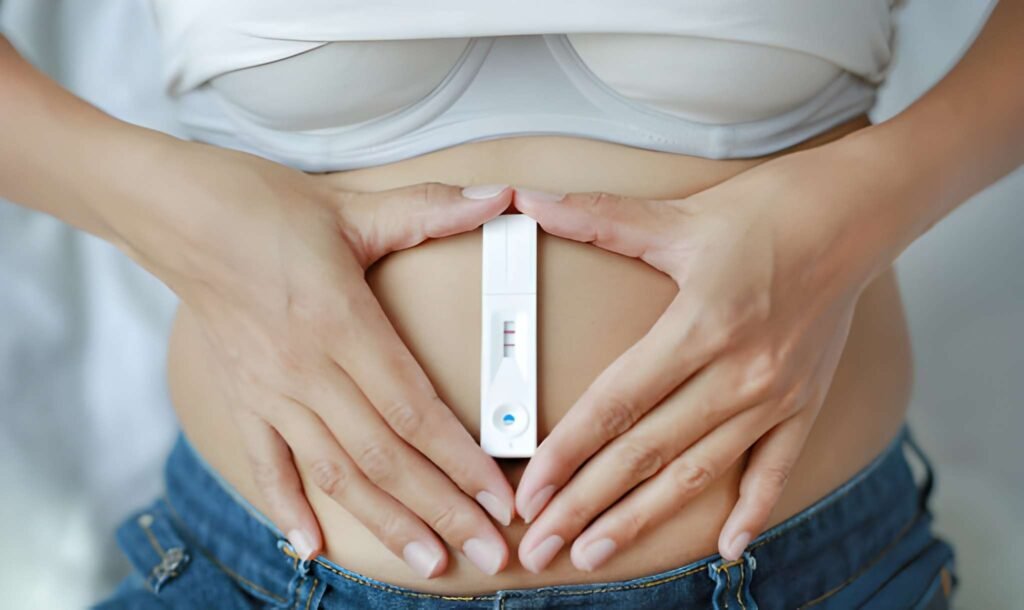
On $14$ DPO, any line, no matter how faint, should be considered a presumptive positive. Home pregnancy tests are qualitative, meaning they tell you if hCG is present. A faint line simply indicates that your hCG level is low but above the test’s threshold (perhaps just $25$ mIU/mL). A darker line suggests a higher concentration of hCG. Do not fixate on the darkness of the line as a measure of pregnancy health; it is only a proxy for hormone concentration at that exact moment.
Understanding Early Loss
When you test this early, there is a possibility you detect what is known as a “chemical pregnancy.” This term describes a pregnancy confirmed by a blood or urine test, but which fails to progress before the gestational sac can be seen on an ultrasound (typically around five weeks gestation). Chemical pregnancies are usually due to chromosomal abnormalities that prevent the embryo from developing properly. While disappointing, they are very common, often occurring without the knowledge of the woman who does not test early. A positive test at $14$ DPO is the first step, and the next steps involve medical confirmation.
Symptom Check: Pregnancy or Premenstrual Syndrome?
The symptoms experienced at $14$ DPO are notoriously ambiguous, often mimicking the signs of impending menstruation. Both early pregnancy and Premenstrual Syndrome (PMS) involve high levels of the hormone progesterone, which causes many overlapping physical feelings. The only definitive difference on $14$ DPO is the presence of hCG, confirmed by the positive test.
However, certain nuances can distinguish early pregnancy symptoms from PMS. Use the interactive accordion below to compare common symptoms and understand the subtle differences.
The Nuances of 14 DPO Symptoms
Pregnancy: Cramping is often described as mild, brief, and feeling more like stretching, twinging, or a pulling sensation. It is usually localized low in the abdomen or on one side. This relates to the uterus expanding and the implantation process.
PMS: Menstrual cramps tend to feel heavier, more generalized, and intensify steadily until menstruation begins. They typically respond well to standard pain relief.
Pregnancy: This is often implantation bleeding. It is typically light pink or brown, very minimal in flow (often only noticeable when wiping), and lasts only a few hours to one or two days. Heavy, bright red flow is usually not implantation bleeding.
PMS: Spotting before a period is possible, but full menstrual flow is heavier, brighter red, and increases in volume over several days.
Pregnancy: Tenderness can be more pronounced, often accompanied by a feeling of heaviness or fullness. Veins may become more noticeable, and the areolas (the pigmented area around the nipple) might darken slightly or become bumpy.
PMS: Breast tenderness is common with progesterone spikes, but the intensity often begins to decrease right before the period starts. The visual changes (veins, darkening) are less typical of PMS.
Pregnancy: Exhaustion can be overwhelming, a deep bone-weariness that goes beyond standard tiredness. Nausea (often incorrectly called "morning sickness") can begin as early as $14$ DPO, striking at any time of day or night.
PMS: Fatigue is common but generally less profound than pregnancy-related exhaustion. Nausea is rare in PMS, though some women experience digestive upset just before their period.
Your Next Steps After a Positive Test
Finding out you are pregnant at $14$ DPO is a monumental, life-changing event. The flood of emotion—whether excitement, relief, or apprehension—is entirely normal. Your focus must now shift from the waiting game to establishing early prenatal care.
1. Contact Your Healthcare Provider
The single most important step is to call your primary care physician or obstetrician/gynecologist (OB-GYN) office. Inform them of your positive home test result and the date of your last menstrual period (LMP), or the date you confirmed ovulation ($14$ DPO is roughly equivalent to $4$ weeks gestation if you have a standard cycle). They will guide you through the process, which often involves:
- Blood Test Confirmation: A quantitative beta-hCG blood test provides the exact level of the hormone, offering confirmation and a baseline for comparison.
- Initial Consultation: The first appointment is usually scheduled between $8$ and $12$ weeks gestation. This is when the first ultrasound, comprehensive blood work, and thorough history intake occurs.
- Progesterone Assessment: Your provider may also test your progesterone levels, especially if there is a history of loss or irregular cycles, as this hormone is crucial for maintaining the uterine lining.
2. Prioritize Lifestyle Changes Immediately
In the absence of concrete medical guidance, treat your body as if the pregnancy is fully established. The first few weeks are crucial for fetal development.
- Supplementation: If you are not already taking a prenatal vitamin containing at least $400$ micrograms of folic acid, begin immediately. Folic acid is critical for preventing neural tube defects.
- Avoidance: Cease consumption of alcohol and tobacco products immediately. Review any current prescription or over-the-counter medications with your doctor or a pharmacist to ensure they are pregnancy-safe. Limit caffeine intake to less than $200$ mg per day (roughly one standard cup of coffee).
- Dietary Precautions: Start adhering to pregnancy safety guidelines regarding food: avoid unpasteurized dairy, raw or undercooked meats/seafood, and high-mercury fish.
3. Navigating the Emotional Transition
The shift from trying-to-conceive (TTC) to expecting can be emotionally demanding. It is common to feel a sense of fragile excitement, often coupled with anxiety, especially in the earliest weeks. The high rate of early loss can make it feel safer to keep the news quiet, and this caution is reasonable. Share the news when and with whom you feel most comfortable. Lean on supportive partners, friends, or family members who understand the weight of this early confirmation. Focus on small, manageable tasks, like scheduling your first appointment, rather than the overwhelming scope of the next nine months.
Interactive: Estimate Your Due Date
A positive test at $14$ DPO means you are approximately $4$ weeks pregnant. This calculation uses the standard medical convention, which counts pregnancy starting from the first day of your last menstrual period (LMP), about two weeks before ovulation. Use this simple calculator to estimate your baby's due date based on the date you ovulated.
Estimated Due Date (EDD)
Select a date to calculate.
The Takeaway on 14 DPO
A positive pregnancy test at $14$ DPO is the moment where science confirms intuition. It is the end of the two-week wait and the beginning of the nine-month journey. The hormone hCG successfully crossed the threshold, signaling the establishment of a pregnancy. Remember to treat this moment with confidence, contact your healthcare provider for clinical confirmation and guidance, and prioritize the foundational elements of healthy living—folic acid, avoidance of toxins, and intentional self-care.