The First Glimmer of Hope After Embryo Transfer
6 Days Post 5-Day Transfer (6dp5dt) Positive: HCG Science, Trigger Shot Risk, and Confirmation Protocol
Table of Contents
The Timeline Translation: 6dp5dt to 11 DPO
Understanding the significance of 6dp5dt requires translating the IVF terminology into the standard gestational clock. A 5-day blastocyst embryo is developmentally equivalent to an embryo that implanted naturally 5 days after ovulation. Therefore, 6 days after the transfer means the total time since fertilization is:
6dp5dt $\rightarrow$ 6 days post transfer + 5 days development = 11 Days Post Ovulation (11 DPO)
Implantation Dynamics
For a 5-day blastocyst, implantation should have occurred very quickly after transfer, typically within 1 to 2 days (1dp5dt or 2dp5dt). By 6dp5dt (11 DPO), the embryo has been signaling its presence to the body for approximately 4 to 5 days. This means the Human Chorionic Gonadotropin (hCG) hormone has had sufficient time to rise exponentially and cross the detection threshold of most sensitive home pregnancy tests (HPTs).
HCG Reliability: Why the Positive is Meaningful
At 6dp5dt (11 DPO), a positive HPT is highly reliable for a natural cycle. In an IVF cycle, where the hormone levels are being medically managed, a positive result indicates that the **embryo is actively producing hCG**. The median hCG level for a viable pregnancy at 11 DPO is typically between 20 and 30 mIU/mL, which is detectable by most high-sensitivity tests (threshold 10 mIU/mL or less) and sometimes even by standard tests (threshold 25 mIU/mL).
The Doubling Rate Advantage
The IVF process bypasses the early implantation delay often seen in natural cycles. Since the blastocyst is ready to implant immediately, the hCG production curve is generally established faster. The positive test at 6dp5dt means the pregnancy is progressing strongly enough to show a clear signal before the official clinic blood test.
The Vexing Question: Is it the Trigger Shot?
The biggest source of anxiety with an early positive test in an IVF cycle is the possibility of detecting residual hCG from the **trigger shot** (e.g., Ovidrel, Novarel, Pregnyl), which is synthetic hCG administered 10 to 14 days before the test date.
Trigger Clearance Timeline
The trigger shot must clear the patient's system completely before a positive test can be trusted. The rate at which the hormone clears depends on the initial dosage and the individual's metabolism, but generally:
- A standard trigger dose (e.g., 10,000 IU) takes approximately **10 to 14 days** to clear below the detection threshold of 25 mIU/mL.
- At 6dp5dt, you are usually 11 days past the trigger shot (5 days to reach transfer, 6 days post-transfer). This timing is extremely close to the clearance window.
If you are testing early, the safest way to distinguish the two is through **line progression** (see below) or by relying on your clinic’s quantitative blood test.
Interactive: Trigger Shot Clearance Analyzer
Use this tool to determine the likelihood that your positive test is due to the residual trigger shot HCG versus a true pregnancy signal. The analysis assumes a standard 10,000 IU trigger shot clears at a typical rate of $10\%$ per day.
Trigger Clearance Analysis at 6dp5dt
The Faint Line: Interpretation and Progression
A positive line at 6dp5dt will likely be faint. The crucial step is observing its **progression** over the next 48 hours. If the line is darkening, it means a **new, functional source of hCG** (the developing placenta) is rapidly overcoming the declining or stabilizing trigger shot levels.
Protocol for Line Monitoring
- Wait 48 Hours: Only retest after a full 48 hours. Testing daily is misleading because the hCG doubling is too slow for a significant visual change.
- Same Brand, FMU: Use the same test brand with the first morning urine (FMU) for the most accurate comparison. A visually darker line provides powerful reassurance.
The Definitive Clinical Protocol: Beta HCG
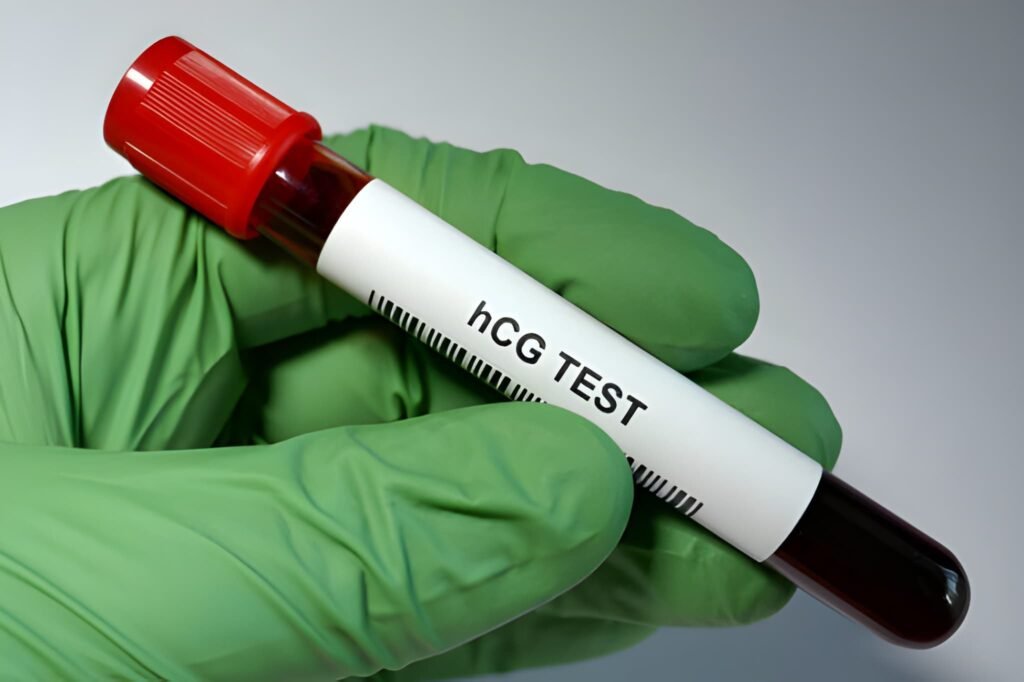
The final confirmation of a viable pregnancy after IVF does not come from a home test, but from a quantitative blood test ordered by the clinic, known as the **Beta HCG** or quantitative HCG test. This test provides an exact number of mIU/mL.
The Official Test Day (Usually 9dp5dt)
Most clinics schedule the official beta test around 9dp5dt (14 DPO). If you tested positive early at 6dp5dt, contact your clinic. They may move the test up or, more commonly, instruct you to test again on the official date.
Confirmation Criteria: Doubling Time
The clinic assesses viability based on the **doubling time** between two successive beta tests, usually taken 48 hours apart. A healthy pregnancy is defined by a level that increases by at least $66\%$ to $100\%$ within that 48-hour window, confirming the embryo is growing rapidly.
Symptoms: Progesterone vs. Pregnancy
At 6dp5dt, physical symptoms are notoriously misleading because you are likely taking high doses of **exogenous progesterone** (suppositories, injections) as part of the luteal phase support. These medications mimic early pregnancy symptoms, causing breast tenderness, fatigue, and bloating.
The only reliable indicator remains the **hCG hormone level**. Ignore subjective symptoms and focus entirely on the objective data provided by line progression and the clinic's quantitative beta test.
Emotional and Financial Realities of Early Testing
The desire to test early is a natural response to the intensity and financial commitment of IVF (a significant socioeconomic stressor in the US). A positive result at 6dp5dt is a moment to celebrate, but it must be managed with emotional caution until the beta test confirmation.
Prioritizing Emotional Health
Allow yourself hope, but maintain a grounded perspective. Use the days between the early HPT and the clinic beta to practice restorative self-care. Focus on rest and consistent intake of prescribed medications, trusting that the work of implantation is complete. The early positive is a powerful indicator that the microscopic journey has successfully progressed to the point of hormonal signal.