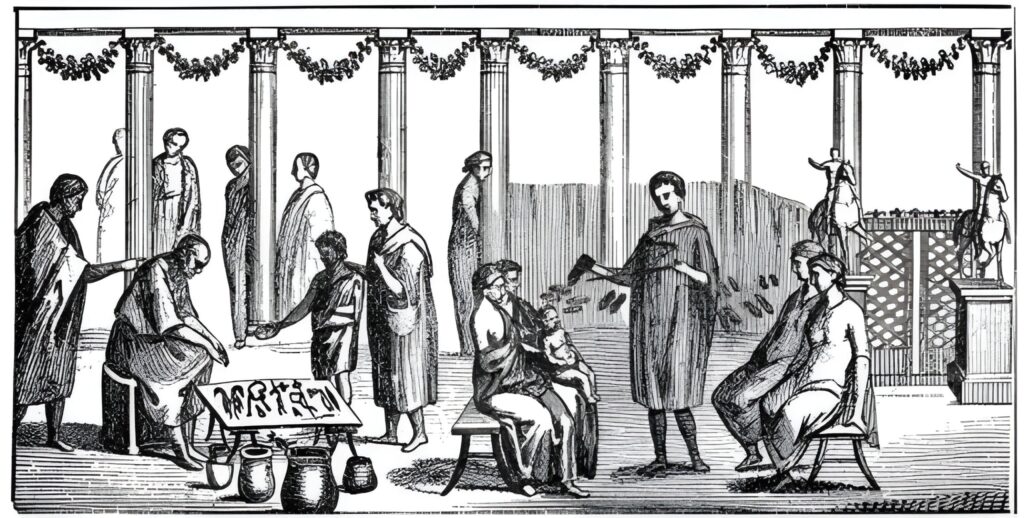
Ancient Roman education was deeply influenced by Greek traditions yet developed distinctive characteristics reflecting Roman values of discipline, citizenship, and practical governance. Understanding this educational system requires turning to primary sources: literary works, inscriptions, letters, philosophical treatises, and accounts by historians. These sources reveal not only the curriculum and pedagogy but also the social expectations and cultural values underlying education in Rome. By examining writings of Cicero, Quintilian, Seneca, Pliny the Younger, inscriptions from schools, and legal codes, one can piece together a vivid picture of how knowledge was imparted and what role it played in Roman society.
Early Roman Education: Family as the First School
Primary sources such as Cato the Elder’s writings highlight that in the early Republic, education was primarily domestic. The father (paterfamilias) was the chief educator, responsible for teaching moral values, family traditions, and basic literacy. Cato’s preserved works, including De Agri Cultura, emphasize practical instruction—agriculture, discipline, and respect for Roman customs. This suggests that Roman education was initially less about formal schooling and more about forming citizens capable of serving the Republic through military, agricultural, and civic duties.
Influence of Greek Education
Greek influence reshaped Roman education beginning in the 3rd century BCE after Rome’s contact with Hellenistic culture. Primary sources such as Polybius’ Histories detail how Romans adopted Greek tutors and curricula. Latin authors themselves acknowledge Greek impact: Cicero’s De Oratore and Seneca’s letters frequently reference Greek models. This blending created a Roman system that maintained utilitarian values while embracing philosophical inquiry and rhetoric from Greece.
Literary Sources on Roman Education
Cicero
Cicero (106–43 BCE) provides some of the richest primary insights into Roman education. In De Oratore, he describes the training of orators, which combined philosophy, rhetoric, and moral instruction. He believed education should form not only a skilled speaker but also a virtuous citizen. His personal letters, such as those to his son Marcus, reveal paternal involvement in education, stressing the study of Greek and Latin literature.
Quintilian
Quintilian’s Institutio Oratoria (c. 95 CE) remains the most comprehensive surviving treatise on Roman education. Written during the Flavian period, it outlines educational stages from early childhood through advanced rhetorical training. He emphasizes starting education early, employing positive reinforcement instead of harsh punishment, and balancing moral instruction with intellectual development. His detailed discussion of curriculum—grammar, rhetoric, philosophy, history—makes this work indispensable for understanding Roman schooling.
Seneca
Seneca’s letters and essays contribute to our understanding of moral education. While he criticized excessive rhetorical ornamentation, he valued philosophy as a guide to ethical living. His Epistulae Morales ad Lucilium demonstrates the Stoic emphasis on self-discipline, rational thought, and inner freedom, showing how Roman education extended beyond technical skills to moral formation.
Pliny the Younger
Pliny’s letters describe his own schooling and provide snapshots of elite Roman educational practices. He recalls teachers, fellow students, and the centrality of literature and oratory. His accounts reveal the social prestige associated with education, as well as the personal networks formed in schools.
Epigraphic and Archaeological Evidence
Inscriptions and graffiti also serve as primary sources for Roman education. Graffiti from Pompeii shows exercises in writing the Latin alphabet and basic arithmetic, illustrating early stages of literacy. Inscriptions dedicated to teachers (grammatici, rhetorici) confirm their professional roles in cities across the empire. Wax tablets discovered at Vindolanda (in Roman Britain) reveal writing practice, school exercises, and even personal letters written by children, providing rare glimpses into everyday learning.
Roman Curriculum: Evidence from Primary Texts
The Roman curriculum can be reconstructed through primary sources:
| Educational Stage | Sources | Content |
|---|---|---|
| Ludus Litterarius (Elementary School) | Pompeii graffiti, Quintilian | Reading, writing, arithmetic, memorization of simple texts |
| Grammaticus (Secondary School) | Cicero, Quintilian | Grammar, Latin and Greek literature, poetry, history, mythology |
| Rhetor (Higher Education) | Cicero, Quintilian, Seneca | Rhetoric, philosophy, law, public speaking, moral philosophy |
These stages reflect an emphasis on progression—from basic literacy to advanced rhetorical skills intended for political life.
The Teacher-Student Relationship
Quintilian’s Institutio Oratoria emphasizes the moral role of teachers, advocating patience, encouragement, and ethical guidance. Inscriptions show that teachers were often respected but not highly paid, leading to social debates about their value. Pliny’s letters and Martial’s epigrams provide insights into teacher salaries and social standing, showing both appreciation and satire.
Gender and Education
Primary sources indicate limited educational opportunities for Roman women, though exceptions existed. Cornelia, mother of the Gracchi, is praised in ancient accounts for her intellectual influence on her sons. Juvenal’s satires suggest that some elite women received rhetorical and philosophical training, though this was viewed with suspicion by conservative Romans. The legal code Digest of Justinian confirms that formal higher education was largely reserved for men.
Law and Education
Roman legal texts also serve as primary evidence. The Lex Iulia and Codex Theodosianus provide regulations on teachers, fees, and state involvement in education. These sources show how, by the imperial period, education had become a recognized profession regulated by law, with emperors offering patronage or financial support to distinguished teachers.
Comparisons with Other Ancient Systems
| Aspect | Ancient Rome | Ancient Greece | Ancient India |
|---|---|---|---|
| Goal of Education | Form virtuous citizens, skilled orators, capable administrators | Develop civic participation, philosophical inquiry | Spiritual liberation, holistic growth |
| Key Sources | Cicero, Quintilian, Seneca, inscriptions | Plato, Aristotle, Homer, inscriptions | Vedas, Upanishads, Buddhist Sutras |
| Methods | Memorization, rhetoric, moral philosophy | Dialogue, rhetoric, mathematics, philosophy | Oral recitation, debate, meditation |
| Institutions | Schools (ludus, grammaticus, rhetor), private tutoring | Academies, gymnasia | Gurukulas, monasteries, universities |
The table shows Rome’s unique balance between practical civic training and philosophical study, in contrast to Greek theoretical focus and Indian spiritual orientation.
Social and Economic Dimensions
Primary sources reveal that access to education in Rome was shaped by class and wealth. Elite families could afford private tutors, often Greek slaves or freedmen, while poorer children relied on public elementary schools. Inscriptions and graffiti demonstrate that literacy rates varied, with urban populations more literate than rural communities. Education was thus both a tool of social mobility and a marker of elite identity.
Legacy of Roman Education
The influence of Roman education endured beyond antiquity. Medieval education in Europe retained the focus on grammar and rhetoric derived from Roman schools. Quintilian’s treatise shaped Renaissance humanist education, while Cicero’s works remained central to Western intellectual tradition. Modern concepts of liberal arts education echo Roman ideals of forming well-rounded individuals capable of public participation.
Conclusion
Primary sources—Cicero’s philosophical dialogues, Quintilian’s detailed treatise, Seneca’s Stoic letters, Pliny’s autobiographical accounts, inscriptions, graffiti, legal codes, and archaeological evidence—together offer a rich understanding of Roman education. They show a system rooted in family tradition, shaped by Greek influence, and developed into a structured progression from basic literacy to advanced rhetorical training. Education in Rome was both a practical necessity for governance and a moral duty for cultivating virtuous citizens. By examining these sources, we see how Romans balanced intellectual rigor with civic responsibility, leaving a legacy that continues to inform educational thought today.