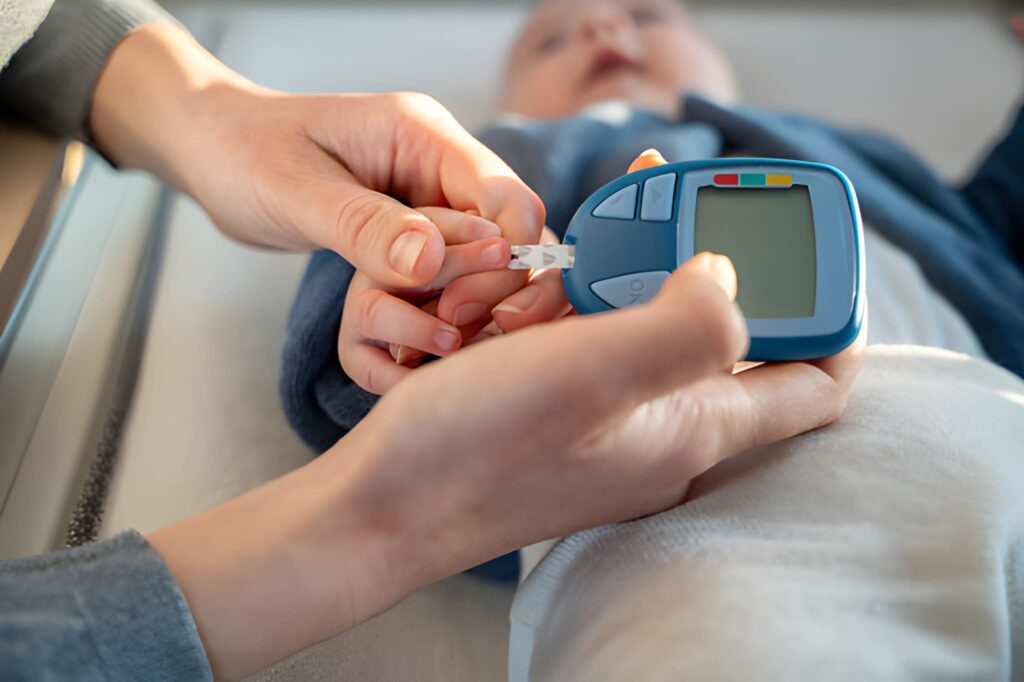
Guarding the Golden Hour: A Specialist Guide to One-Hour Hypoglycemia Monitoring
Expert insights into the physiological transition of newborns, clinical risk identification, and emergency glucose management in the first hour of life.
The Physiological Glucose Transition
The moment a baby leaves the womb, their source of continuous fuel vanishes. Inside the uterus, the placenta provides a steady stream of maternal glucose, maintaining the fetus at roughly 70 percent of the mother’s blood sugar levels. Upon birth, the umbilical cord is clamped, and the newborn must suddenly activate their own metabolic machinery to maintain energy balance.
In response to this abrupt cessation of supply, the newborn’s body releases a surge of catecholamines—stress hormones like adrenaline and noradrenaline. These hormones trigger glucagon release and suppress insulin, stimulating the liver to break down stored glycogen into glucose. This process, known as glycogenolysis, is the infant’s primary defense against falling energy levels in the first few hours of life. For a specialist, monitoring this transition is the highest priority during the "Golden Hour."
Understanding the One-Hour Nadir
Physiologically, a newborn's blood glucose concentration reaches its lowest point—the nadir—between one and two hours after birth. In healthy, full-term infants, this level typically stabilizes and begins to rise by the third hour, even without immediate feeding. However, for many infants, this stabilization fails.
The 1-hour mark is the standard checkpoint because it represents the peak of metabolic stress. If the infant has insufficient glycogen stores (as seen in premature or small infants) or if they have excessive insulin (as seen in babies of diabetic mothers), their blood sugar will continue to drop past the 1-hour mark rather than rebounding. This is why nurses are trained to perform the first screening precisely at the 60-minute mark for high-risk babies.
Identifying High-Risk Candidates
Not every baby requires a heel stick for glucose monitoring. Over-testing can lead to unnecessary discomfort and family anxiety. We categorize infants into risk groups based on their likelihood of metabolic failure.
Infants of Diabetic Mothers (IDM)
These babies have been exposed to high glucose in utero, leading to overactive fetal insulin. Once born, the insulin remains high, but the glucose supply vanishes, causing a rapid crash.
Large for Gestational Age (LGA)
Infants weighing above the 90th percentile often experience hyperinsulinism, similar to IDMs, even if the mother did not have diagnosed diabetes.
Small for Gestational Age (SGA)
Babies below the 10th percentile lack the liver glycogen and fat stores necessary to generate fuel during the transition period.
Late Preterm Infants
Babies born between 34 and 36 weeks often have immature metabolic pathways and poor feeding coordination, increasing their risk of exhaustion.
Clinical Signs of Neonatal Hypoglycemia
Hypoglycemia in the first hour of life is often "silent," meaning the infant shows no obvious distress. However, when symptoms do appear, they are often subtle and can be easily mistaken for normal newborn behavior or other conditions like sepsis.
The brain is the primary consumer of glucose. Signs include jitteriness (tremors that stop when the limb is held), high-pitched crying, irritability, and in severe cases, seizures. A weak or absent suck reflex is a common early indicator.
The body’s attempt to compensate can lead to tachypnea (fast breathing), temperature instability (cold stress), and cyanosis (bluish tint to the skin). Apnea, or pauses in breathing, may also occur.
Lethargy is a major red flag. If a 1-hour-old infant is difficult to arouse or appears "floppy" (hypotonia), immediate glucose screening is mandatory regardless of risk group status.
Standardized Screening Protocols
The American Academy of Pediatrics (AAP) provides specific thresholds for intervention. These numbers are lower than what we expect in adults because newborns have a higher tolerance for low glucose as they transition to ketone-based energy. However, falling below these thresholds requires immediate action.
| Timeframe | Target Level (mg/dL) | Intervention Threshold | Action Required |
|---|---|---|---|
| Birth to 4 Hours | Above 40 mg/dL | Below 25 mg/dL | Immediate IV Glucose or Dextrose Gel |
| 4 to 24 Hours | Above 45 mg/dL | Below 35 mg/dL | Feed and Recheck in 1 Hour |
| Symptomatic (Any time) | Target 45+ mg/dL | Below 40 mg/dL | Immediate clinical intervention |
Emergency Interventions and Feeding
If the 1-hour glucose screen reveals low levels, the nurse must act quickly. The first line of defense for a stable, asymptomatic infant is always colostrum. Breast milk is not just food; it contains bio-available sugars and fats that stimulate the baby's own metabolism.
If the baby is unwilling or unable to breastfeed, or if the levels are dangerously low (below 25 mg/dL), we utilize 40% Dextrose Gel. This gel is massaged into the buccal mucosa (the inside of the cheek). It provides a rapid sugar spike without the risks associated with IV placement or formula supplementation. Research shows that using dextrose gel significantly reduces NICU admissions for hypoglycemia.
GIR: Glucose Infusion Rate Calculation
When oral feedings and dextrose gel fail to stabilize blood sugar, we initiate a continuous IV infusion of dextrose. To ensure the brain receives a steady supply, we calculate the Glucose Infusion Rate (GIR). This measures how many milligrams of glucose the baby receives per kilogram of body weight per minute.
Clinical GIR Formula
To calculate GIR without complex software, use this simplified formula:
GIR = (Percent Dextrose multiplied by Rate in ml/hr) divided by (6 multiplied by Weight in kg)
Example: A 3.0 kg baby receiving D10W (10% dextrose) at a rate of 12 ml/hr.
Calculation: (10 multiplied by 12) divided by (6 multiplied by 3.0) = 120 divided by 18 = 6.6 mg/kg/min.
A normal starting GIR for a newborn is usually between 4 and 6 mg/kg/min.
Long-Term Preventative Strategies
Prevention starts before the 1-hour screen. We emphasize the "Three Pillars of Glucose Stability" for all newborns:
1. Skin-to-Skin Contact: This regulates the infant’s temperature. A cold baby uses up their glucose stores three times faster to generate heat. Keeping the baby warm preserves their fuel.
2. Early and Frequent Feeding: We aim for the first breastfeeding session to occur within the first 30 to 60 minutes of life. Early colostrum intake primes the liver to begin its own glucose production.
3. Minimal Disturbance: We perform assessments and screenings while the baby is on the mother’s chest whenever possible. Reducing stress hormones prevents the unnecessary depletion of glycogen stores.
Summary Checklist for Nurses
- Validate the Risk: Identify IDM, LGA, SGA, or preterm status immediately upon delivery.
- Timed Testing: Perform the first heel stick at exactly 60 minutes of age for at-risk infants.
- Symptom Check: Assess for jitteriness, lethargy, or poor muscle tone every 15 minutes during the first hour.
- Temperature Control: Ensure the infant remains skin-to-skin or under a radiant warmer during the transition.
- Documentation: Record the time of the first feed and the exact glucose value to establish a metabolic trend.
The first hour of life is a metabolic bridge between two worlds. Through vigilant monitoring, precise screening at the one-hour mark, and rapid intervention with feeding or dextrose gel, we ensure that every newborn has the fuel they need to begin their life with a healthy, thriving brain.