Scientific Efficacy at an Accessible Price Point
Low-Cost Pregnancy Tests: Accuracy, Strategy, and Use
Table of Contents
- The Economics of Early Detection and Low-Cost Testing
- The Core Science: Why Cheap Tests Work
- Strategic Advantage: Testing in Volume
- Disadvantages: Risk Management and Interpretation
- Maximizing Accuracy: Usage Instructions for Low-Cost Tests
- Socioeconomic Context: Access and Anxiety
- Interactive Guide: Maximizing Test Accuracy
- Calculation: Cost-Per-Test Analysis
The Economics of Early Detection and Low-Cost Testing
The rise of low-cost home pregnancy tests (HPTs)—often sold in bulk online or for under one dollar (the "99-cent test")—has fundamentally changed the landscape of the trying-to-conceive (TTC) journey. These tests provide frequent testers with an economically viable way to manage the intense psychological pressure of the "Two Week Wait." The primary appeal is not marginal savings, but the ability to purchase volume: dozens of tests for the price of one branded stick.
This accessibility is vital for American families, where the average cost of a premium digital test can be high. Frequent testing allows individuals to track their cycle meticulously, gain certainty sooner, and move rapidly into either prenatal care or cycle reassessment without the financial burden previously associated with the process. The question shifts from "Should I test?" to "How can I use these tests most effectively?"
The Core Science: Why Cheap Tests Work
The fundamental scientific principle underlying a $99$-cent test is identical to that of a $15$ digital test: the **lateral flow immunoassay**. These low-cost tests work because the critical component—the antibody strip—is inexpensive to manufacture once scaled.
The Role of the Antibody Strip
Every home pregnancy test, regardless of price, uses specialized monoclonal antibodies engineered to bind specifically to the Human Chorionic Gonadotropin (hCG) hormone in the urine. When urine passes over the strip, the hCG, if present, binds to the antibodies, causing a chemical reaction that results in a visible dye line.
The difference in cost primarily reflects packaging, advertising, and the addition of a digital casing, not the accuracy of the underlying chemistry. A cheap test is simply the chemical detection strip in its most minimal plastic housing.
HCG Sensitivity and Thresholds
Accuracy in early testing is determined by a test's **sensitivity**, measured in milli-international units per milliliter (mIU/mL). A lower number indicates higher sensitivity.
| Test Type | Typical Sensitivity Threshold (mIU/mL) | Earliest Reliable DPO |
|---|---|---|
| Low-Cost Strips ($0.99 - $1.50) | 20 - 25 | 12 to 14 DPO |
| Premium Brand Strip (Analog) | 10 - 25 | 10 to 12 DPO |
| Digital Test (Clearblue, First Response) | 6.3 - 25 | 9 to 12 DPO |
Many low-cost strips are standardized to detect $25$ mIU/mL. While the very highest sensitivity tests (like First Response) can sometimes detect hCG as low as $6.3$ mIU/mL, the $25$ mIU/mL threshold is still highly reliable by $14$ DPO (the day of the missed period) for nearly all viable pregnancies.
Strategic Advantage: Testing in Volume
The economic value of low-cost tests allows for testing strategies that would be prohibitively expensive with premium brands. This shift in affordability enables individuals to practice controlled testing frequently, which can reduce anxiety by providing objective daily data.
Cost-Per-Test Analysis
The psychological relief provided by a low-cost test outweighs the minimal difference in sensitivity for many. The cost saving is substantial, supporting the high-volume testing often desired by those tracking early.
Calculation: Cost-Per-Test Analysis
Scenario A: Premium Brand
Cost per test kit: $18.00
Tests included: 2
Cost per test: $9.00
Scenario B: Low-Cost Bulk Strips
Cost per kit: $12.00
Tests included: 50
Cost per test: $0.24
The difference in cost (up to $8.76 per test) demonstrates why low-cost tests are the preferred tool for high-volume, repetitive testing during the mid-luteal phase.
Testing Out the Trigger
In fertility treatments (IUI/IVF), patients are often given an hCG "trigger shot" to induce ovulation. Since the injected hormone causes an immediate positive result (a false positive), patients use low-cost strips daily to track the hormone's departure from the system. This practice, known as "testing out the trigger," allows the user to confirm when the injected hCG is gone, enabling them to confidently detect the onset of naturally rising pregnancy hCG when it appears. This clinical strategy is financially feasible only through the use of low-cost, bulk test strips.
Disadvantages: Risk Management and Interpretation
While cheap tests utilize reliable technology, their minimal design introduces specific risks and challenges related to visual interpretation.
Evaporation Lines and Ambiguity
The most common pitfall of low-cost strips is the **evaporation line**. When a test dries, a faint, colorless line may appear in the result window due to the chemical residue of the dye area. This line is often mistaken for a positive result, especially by those testing early (before the line would be dark).
- Mitigation: Evaporation lines can be avoided by strictly adhering to the manufacturer's specified reading time (usually $3$ to $5$ minutes) and discarding the test immediately after the window closes.
Lack of Line Progression Clarity
Individuals often track the darkening of the line over successive days to visually confirm the doubling of hCG (a good sign of viability). Low-cost strips sometimes utilize lower dye concentrations or less consistent antibody loading, making the line progression fainter, more ambiguous, or less visually striking than premium brands. This can inadvertently increase anxiety, despite the pregnancy progressing normally.
Quality Control and Reliability
While rare for major bulk sellers, occasional issues with quality control can result in "dye runs" (dye that spreads unevenly) or strips with zero active antibodies. Buying from reputable bulk suppliers who are FDA-registered helps mitigate this risk, ensuring the strips meet necessary clinical standards.
Maximizing Accuracy: Usage Instructions for Low-Cost Tests
The accuracy of a low-cost test relies more heavily on perfect execution than a packaged digital test. Simple adherence to clinical standards can maximize reliability.
First Morning Urine (FMU) is Mandatory
For early detection (before $14$ DPO), using the **First Morning Urine (FMU)** is non-negotiable. HCG levels are most concentrated in the FMU because the body has processed the hormone over several hours while sleeping. Later in the day, consuming liquids rapidly dilutes the hormone concentration, often leading to a false negative result, especially if implantation occurred late.
The Dip and Timing Rule
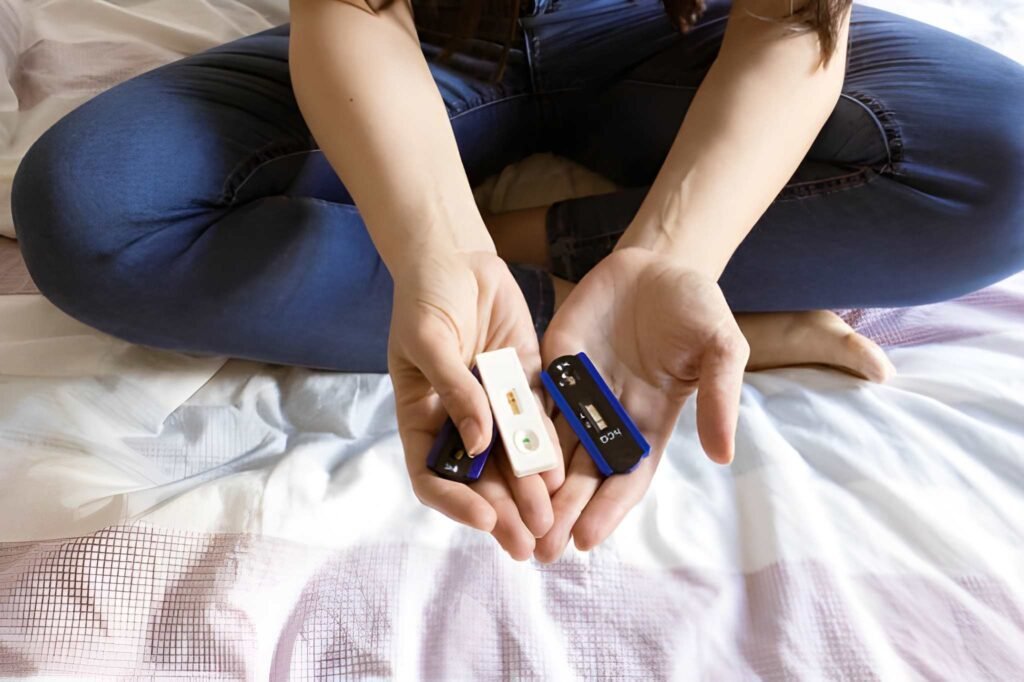
Low-cost strips are "dip-and-read" tests, requiring the user to collect urine first.
- Clean Collection: Always collect the urine in a clean, dry container to prevent contamination.
- Dip Depth: Do not dip the strip past the marked MAX line. Over-saturating the strip can flood the detection window, leading to dye run and an invalid result.
- Strict Timing: Use a timer to read the result at the exact time specified (e.g., $5$ minutes). Disregard any result—positive or negative—that appears after this window closes.
Socioeconomic Context: Access and Anxiety
In the socioeconomic context of the US, the availability of low-cost tests is a health equity issue. The anxiety surrounding fertility and pregnancy is profound, driving frequent testing behavior. For low-income individuals or those with limited health insurance access, the expense of high-end tests can be a barrier to early confirmation and prenatal care initiation.
Low-cost tests serve as a crucial entry point: they provide the initial, definitive answer needed to trigger the first prenatal visit. A woman who confirms a positive result using a bulk strip can then confidently seek specialized care, utilizing state programs like Medicaid or WIC (Women, Infants, and Children) for ongoing nutritional support. The democratization of early testing through affordable strips ultimately supports better public health outcomes by enabling timely clinical action.
Interactive Guide: Maximizing Test Accuracy
Ensure the most accurate results possible with your low-cost test by adhering to these usage steps.
Step 1: Timing and Preparation ▼
Always test with **First Morning Urine (FMU)**, especially before $14$ DPO. Have a clean cup and a reliable timer ready.
Step 2: Dipping Technique ▼
Dip the test strip into the urine sample for the duration specified (usually $5$ to $10$ seconds). Never dip past the maximum marked line. Place the strip flat on a dry surface.
Step 3: Reading the Result ▼
Read the result at the exact time specified by the manufacturer (usually $3$ to $5$ minutes). Disregard any faint line that appears after this window, as it may be an evaporation line.
Calculation: Cost-Per-Test Analysis
The primary motivation for using low-cost tests is the extreme difference in cost-per-test, enabling high-volume testing for the TTC community.
Scenario: Cost to Test Daily from 9 DPO to 14 DPO
Total tests required: 6
Premium Digital Cost
Cost per test: $15.00
Total cost for 6 tests: $90.00
Low-Cost Strip Cost
Cost per test: $0.25
Total cost for 6 tests: $1.50
The difference highlights the critical role of low-cost testing in reducing the emotional and financial strain of the "Two Week Wait."
Conclusion: Confidence Through Volume and Science
Low-cost, bulk pregnancy tests—epitomized by the $99$-cent strip—are a valid and valuable tool in the fertility journey. They function on the same scientific principle as their expensive counterparts, often possessing sufficient sensitivity to detect pregnancy by $14$ DPO. The confidence in using these tests stems from understanding their limitations: they require stricter adherence to timing and reading protocols to mitigate the risk of evaporation lines. When used strategically in volume, low-cost strips empower frequent testers to gain definitive answers sooner, facilitating prompt entry into crucial prenatal care and supporting mental well-being during the uncertain waiting period.