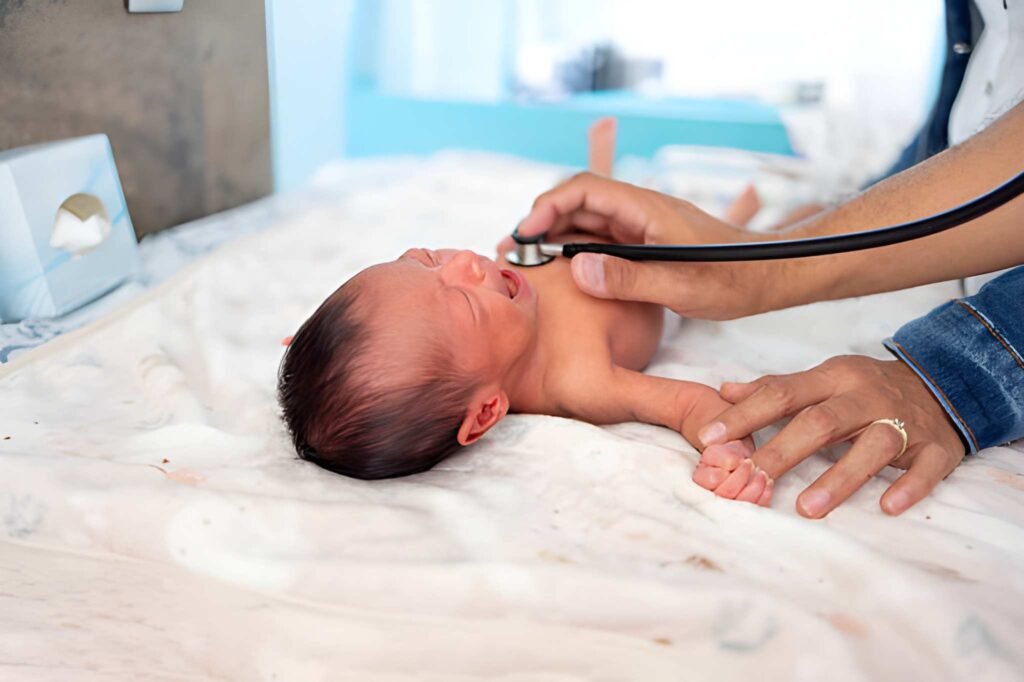
Respiratory Distress in the Full-Term Newborn: A Clinical Evaluation Guide
The Presentation of the Full-Term Newborn
Respiratory distress in a full-term newborn remains one of the most common reasons for admission to the Neonatal Intensive Care Unit (NICU). While healthcare providers expect respiratory challenges in preterm infants due to surfactant deficiency, a term infant should transition to air breathing seamlessly. When a full-term female or male newborn develops respiratory distress, clinicians must act with precision to differentiate between benign transitional issues and life-threatening conditions.
The transition from a fluid-filled lung environment to an air-breathing state involves complex physiological shifts. The first breath requires high inspiratory pressure to clear fetal lung fluid and establish functional residual capacity. Any disruption in this process—whether due to cesarean delivery, maternal sedation, or infection—manifests as clinical distress. Practitioners must remain vigilant during the "golden hour" following birth, as early intervention significantly improves long-term outcomes.
Identifying Clinical Signs of Distress
Respiratory distress is a clinical diagnosis based on the observation of the infant’s work of breathing. The clinician evaluates several specific physical markers that indicate the infant is struggling to maintain adequate oxygenation and ventilation.
A respiratory rate exceeding 60 breaths per minute. This is often the earliest sign of distress as the newborn attempts to compensate for poor gas exchange or hypercapnia.
The sound produced when the infant breathes out against a partially closed glottis. This maneuver increases end-expiratory pressure, helping to keep the alveoli open.
A visible widening of the nostrils during inspiration. This reduces upper airway resistance and reflects the infant’s increased effort to pull air into the lungs.
Visible pulling of the skin around the ribs (intercostal), above the collarbone (suprasternal), or below the sternum (substernal). These indicate significant use of accessory muscles.
Differential Diagnosis in Term Infants
The differential diagnosis for a term newborn differs significantly from that of a preterm baby. While Respiratory Distress Syndrome (RDS) occurs in term babies, other etiologies are much more prevalent.
| Condition | Pathophysiology | Clinical Hallmark |
|---|---|---|
| TTN | Delayed clearance of fetal lung fluid | Rapid breathing, resolves in 24-72 hours |
| MAS | Aspiration of meconium-stained fluid | History of meconium, barrel chest |
| PPHN | Failure of pulmonary vascular resistance to drop | Labile oxygenation, differential cyanosis |
| Pneumonia | Congenital or early-onset infection | Systemic instability, temperature change |
| Air Leaks | Pneumothorax or pneumomediastinum | Sudden deterioration, shifted heart sounds |
Respiratory Scoring Systems
Standardized scoring systems provide an objective language for describing the severity of distress. The Silverman-Andersen score and the Downe’s score are the two most frequently utilized tools in neonatal care.
The Downe’s score evaluates five criteria: Respiratory rate, cyanosis, air entry, grunting, and retractions. Each is scored from 0 to 2.
- Score < 4: Mild distress; monitor closely.
- Score 4-6: Moderate distress; requires oxygen or CPAP.
- Score > 6: Severe distress; immediate NICU intervention and possible ventilation.
This score focuses specifically on the mechanics of breathing, including chest-abdominal synchronization. A higher score indicates greater distress. Unlike Apgar scores, a "high" Silverman-Andersen score is a concerning sign.
Primary Diagnostic Tools
Once clinical distress is identified, the clinician initiates a diagnostic workup to pinpoint the underlying cause. Time is of the essence, as rapid progression can lead to respiratory failure.
Chest Radiography
The chest X-ray remains the gold standard for differentiating TTN from pneumonia or MAS. In TTN, the clinician observes prominent perihilar streaking and fluid in the interlobar fissures. In MAS, the lungs appear hyperinflated with "patchy" infiltrates. A pneumothorax presents as a visible line of pleural separation with no lung markings beyond it.
Arterial Blood Gas (ABG) Analysis
An ABG provides definitive data on the infant’s acid-base balance and oxygenation status. Clinicians look for hypercapnia (high CO2) indicating ventilation failure or hypoxemia (low O2) indicating oxygenation failure.
Calculating the Oxygenation Index (OI)
The OI helps clinicians determine the severity of lung injury and the need for advanced therapies like inhaled Nitric Oxide (iNO) or Extracorporeal Membrane Oxygenation (ECMO).
Formula: (Mean Airway Pressure x FiO2 x 100) / PaO2Example Case:
Mean Airway Pressure (MAP): 12 cmH2O
FiO2: 1.0 (100% Oxygen)
PaO2: 50 mmHg
Calculation: (12 x 1.0 x 100) / 50 = 24
Outcome: An OI > 25 indicates severe respiratory failure and may trigger an ECMO consult.
Intervention and Management Protocols
Management of the full-term infant with respiratory distress follows a "step-up" approach, beginning with the least invasive support and escalating based on the infant's response.
Oxygen Therapy and CPAP
Oxygen therapy begins with a nasal cannula or an oxygen hood. If the infant fails to maintain saturations above 90-94% on supplemental oxygen, the clinician escalates to Continuous Positive Airway Pressure (CPAP). CPAP provides a constant pressure that prevents alveolar collapse, effectively treating TTN and mild RDS.
Empiric Antibiotics
Because neonatal pneumonia and sepsis are indistinguishable from TTN or MAS in the early hours, clinicians often start empiric antibiotics (typically Ampicillin and Gentamicin) after obtaining blood cultures. If the cultures remain negative for 48 hours and the infant improves, the clinician discontinues the treatment.
Management of meconium aspiration syndrome may require surfactant replacement therapy. Although meconium-stained infants are not surfactant-deficient, the meconium inactivates existing surfactant. Lavage or high-dose surfactant replacement can improve lung compliance and gas exchange in these cases.
In summary, the development of respiratory distress in a full-term newborn demands a systematic, evidence-based response. By identifying the specific physical signs, utilizing standardized scoring, and applying appropriate diagnostic imaging, clinicians can effectively manage the transition from intrauterine to extrauterine life. Most term infants recover fully with supportive care, but the ability to recognize surgical emergencies or severe persistent pulmonary hypertension remains a fundamental skill in neonatal medicine.