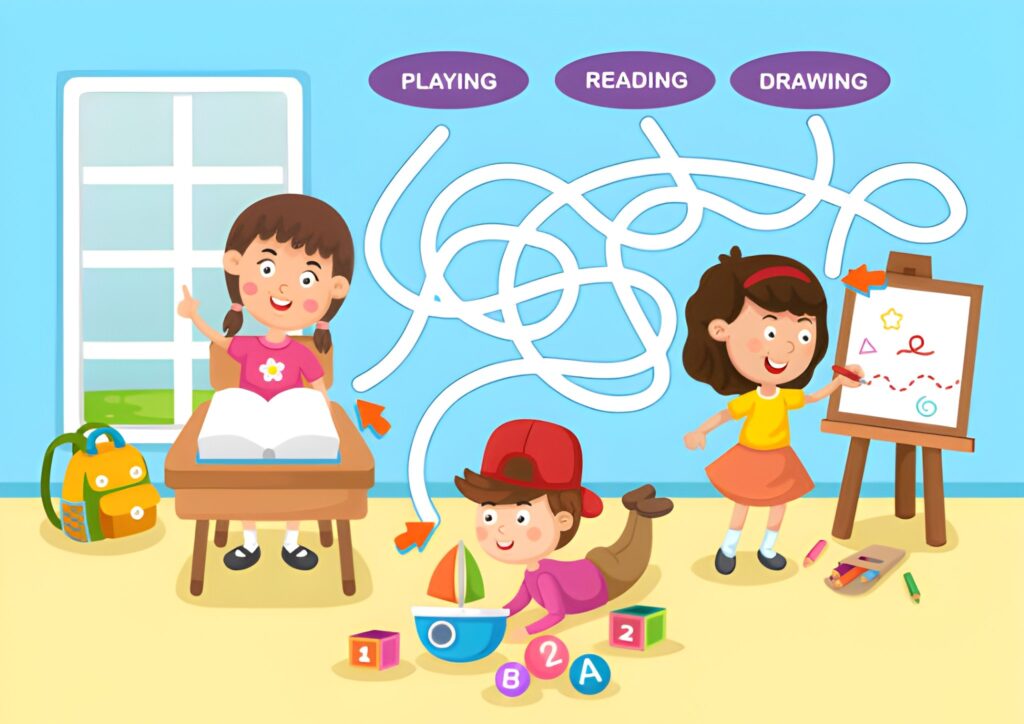
Cognitive development refers to the growth of a child’s ability to think, learn, reason, and solve problems. Supporting cognitive skills from an early age lays the foundation for academic success, critical thinking, and lifelong learning. Parents and caregivers play a crucial role in providing stimulating experiences that foster brain growth, curiosity, and problem-solving abilities.
10 Ways to Promote Cognitive Development in Children
- Engage in Interactive Play
Games like building blocks, puzzles, and shape sorters encourage problem-solving, spatial awareness, and critical thinking. Interactive play also strengthens memory and attention. - Read Regularly Together
Reading aloud exposes children to new vocabulary, language patterns, and concepts. Discussing stories enhances comprehension, imagination, and analytical thinking. - Encourage Exploration and Curiosity
Allow children to explore their environment safely. Outdoor play, sensory activities, and hands-on experiences help them understand cause-and-effect relationships and develop observational skills. - Provide Age-Appropriate Learning Materials
Use toys, games, and educational resources suitable for your child’s developmental stage. Materials that challenge them just enough without causing frustration stimulate cognitive growth. - Ask Open-Ended Questions
Encourage children to think critically and express their ideas by asking questions that require explanation rather than simple yes/no answers. For example, “Why do you think this happens?” promotes reasoning. - Incorporate Music and Rhythms
Music activities enhance memory, pattern recognition, and auditory processing. Singing songs, clapping to rhythms, and exploring instruments stimulate multiple areas of the brain. - Encourage Problem-Solving Activities
Provide opportunities for children to solve simple problems independently, such as figuring out how to stack blocks or complete a puzzle. Gradually increase complexity as they gain confidence. - Promote Social Interaction
Playing with peers and engaging in group activities helps children develop perspective-taking, negotiation, and communication skills, all of which support cognitive and social-emotional growth. - Introduce Basic Math and Science Concepts
Counting objects, sorting by size or color, exploring nature, and conducting simple experiments foster logical reasoning and scientific thinking. Real-life applications make learning meaningful. - Create a Stimulating and Supportive Environment
A safe, organized, and enriched environment encourages exploration and learning. Limit distractions, provide access to books and educational materials, and support curiosity with encouragement rather than pressure.
Conclusion
Promoting cognitive development requires a combination of interactive play, learning opportunities, social engagement, and a stimulating environment. By incorporating these ten strategies into daily routines, parents and caregivers can nurture critical thinking, problem-solving, creativity, and language skills, giving children a strong foundation for lifelong learning and success.