The first 18 months of life represent one of the most transformative stages in human development. During this short period, infants progress from complete dependence to the beginnings of independence, establishing the foundations of emotional security, cognition, social interaction, and language. Developmental child psychology examines these processes by integrating biological growth, psychological theories, cultural practices, and environmental factors. From birth, infants engage with their caregivers and surroundings, absorbing information at a rapid pace. Their brains undergo immense changes, and every interaction contributes to shaping their emerging sense of self and worldview. Understanding development during this stage allows caregivers, educators, and policymakers to better support infants and create environments conducive to healthy growth.
Theoretical Foundations of Infant Development
Several influential theories explain the psychological processes of infancy. Freud described the first year as the oral stage, where the mouth becomes the center of exploration and gratification. While his ideas are less emphasized today, he was among the first to recognize the significance of early experiences. Erik Erikson’s psychosocial model highlighted the task of trust versus mistrust as the central challenge of infancy. Secure care fosters confidence in others, while inconsistent or neglectful care can contribute to mistrust. Jean Piaget introduced the sensorimotor stage, where infants learn through active exploration. Cognitive milestones include learning object permanence and understanding cause and effect. John Bowlby and Mary Ainsworth focused on attachment, emphasizing that infants are biologically predisposed to seek close relationships with caregivers. Their research showed how secure versus insecure attachment styles shape later personality and social outcomes. Lev Vygotsky stressed the sociocultural context, where learning arises through guided interactions and shared activities. Even in infancy, the role of caregiver scaffolding is central to language and emotional regulation.
Neurological and Biological Growth
The human brain develops at remarkable speed in the first 18 months. At birth, it contains nearly all the neurons it will ever have, but synaptic connections multiply rapidly, reaching trillions by the end of the first year. Myelination enhances communication between brain cells, allowing faster processing and better coordination. Early neural growth creates a sensitive period during which experiences profoundly shape brain structure and function. Sleep, nutrition, and stimulation all influence development. Infants who receive consistent sensory and emotional input show stronger neural integration, while deprivation can hinder progress.
Table 1: Key Neurological Developments (0–18 months)
| Age Range | Neurological Milestones | Psychological Implications |
|---|---|---|
| 0–3 months | Rapid synaptogenesis, primitive reflexes dominate | Reflex-driven behaviors, early sensory exploration |
| 4–6 months | Myelination of motor pathways, growth in visual cortex | Improved voluntary movement, sharper vision, eye-hand coordination |
| 7–9 months | Hippocampal development, prefrontal growth | Enhanced memory, recognition of familiar people, separation anxiety begins |
| 10–12 months | Synaptic growth in language centers | Babbling evolves into first words, gestures become meaningful |
| 13–18 months | Frontal lobe refinement | Early problem-solving, attempts at self-control, recognition of self in mirror |
Sensory and Perceptual Development
Vision at birth is limited, but infants can focus on faces within 8–12 inches, facilitating bonding during feeding. By six months, acuity improves dramatically, enabling depth perception and tracking of moving objects. Hearing is functional even before birth, and newborns recognize their mother’s voice within days. By 6 months, infants discriminate a wide range of phonemes, though this narrows to native language sounds around 10–12 months. Touch, smell, and taste are also well developed at birth. Touch provides comfort and security, while familiar scents, such as a caregiver’s natural smell, help orient infants. Taste preferences emerge early, with infants naturally favoring sweet flavors.
Motor Development and Its Psychological Impact
Motor skills allow infants to explore their world, supporting both cognitive and emotional growth. In the early months, reflexes dominate, including rooting, grasping, and the Moro startle response. By 3–4 months, voluntary movements emerge as infants lift their heads and begin rolling. Between 6 and 9 months, they sit independently, crawl, and experiment with mobility. By the end of the first year, many infants pull to stand and take first steps. Walking typically emerges between 12 and 15 months, although variation is common. With mobility comes autonomy, curiosity, and risk-taking. These achievements support self-confidence but also require careful supervision.
Table 2: Motor Development Timeline (0–18 months)
| Age | Gross Motor Skills | Fine Motor Skills |
|---|---|---|
| 0–3 months | Lifts head briefly, kicks legs | Grasps reflexively |
| 4–6 months | Rolls over, sits with support | Reaches for objects, transfers items between hands |
| 7–9 months | Sits independently, begins crawling | Rakes small objects, improved hand-eye coordination |
| 10–12 months | Pulls to stand, cruises along furniture | Pincer grasp develops, points with finger |
| 13–18 months | Walks independently, attempts climbing | Stacks blocks, scribbles with crayon, feeds self with fingers |
Emotional Development and Early Attachment
Infants express emotions from birth, beginning with distress, contentment, and interest. By 2–3 months, social smiling emerges, marking one of the first reciprocal interactions with caregivers. Around 6–8 months, infants display fear of strangers and separation anxiety, both signs of secure attachment and cognitive recognition of caregiver roles. Attachment styles crystallize by the end of the first year. Securely attached infants use caregivers as a safe base for exploration, while insecure attachment patterns—avoidant, ambivalent, or disorganized—reflect inconsistent or inadequate responses to infant needs. Early emotional development also includes the emergence of self-awareness. By 15–18 months, mirror recognition demonstrates growing self-concept, and toddlers begin showing pride, embarrassment, and empathy.
Cognitive Development and Early Learning
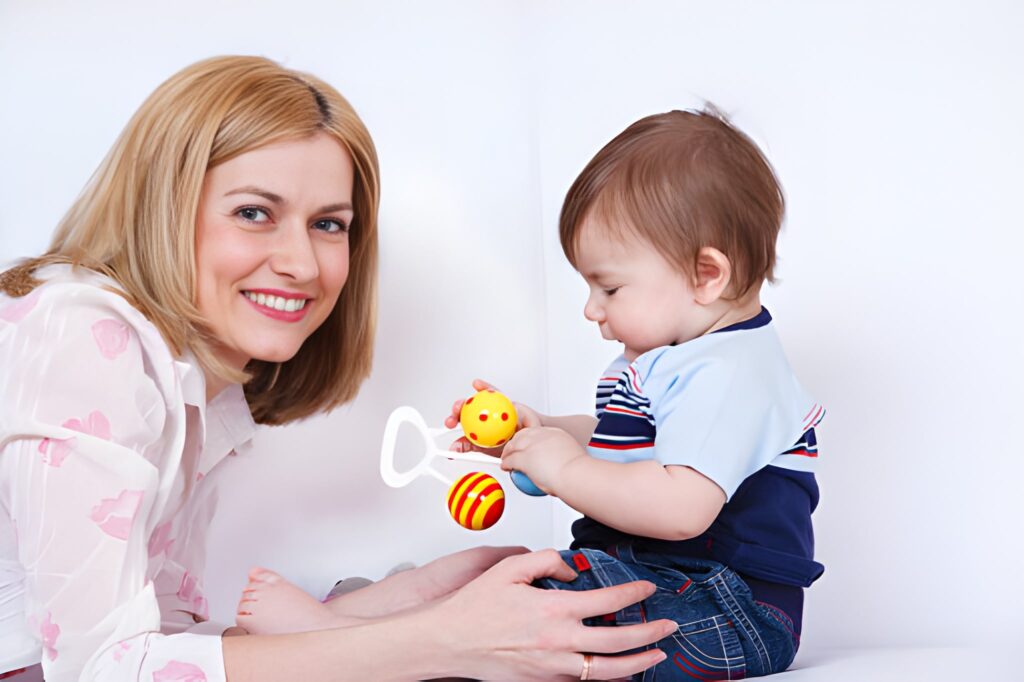
Cognitive milestones progress rapidly in the sensorimotor stage. In the first months, infants learn to coordinate reflexes with intentional action. At 4–6 months, they explore cause-and-effect by shaking rattles or dropping objects. By 8–12 months, object permanence appears, allowing infants to understand that unseen objects still exist. This capacity supports memory, problem-solving, and symbolic play. Language also advances quickly. From cooing at 2 months to babbling at 6 months, infants build sound repertoires. By the first birthday, many say their first words, often names of people or familiar objects. Between 12 and 18 months, vocabulary grows to 20–50 words, and toddlers begin combining gestures with speech to communicate needs and emotions.
Table 3: Cognitive and Language Milestones
| Age Range | Cognitive Skills | Language Skills |
|---|---|---|
| 0–3 months | Tracks moving objects, responds to familiar voice | Cries vary for needs, cooing begins |
| 4–6 months | Explores objects orally, recognizes cause-effect | Babbling with consonant sounds |
| 7–9 months | Understands object permanence, searches for hidden items | Responds to name, imitates sounds |
| 10–12 months | Problem-solves simple tasks, engages in symbolic play | First words, intentional gestures like waving |
| 13–18 months | Identifies body parts, follows one-step commands | Vocabulary expands, combines words with gestures |
Cultural and Socioeconomic Influences
In the United States, socioeconomic disparities affect infant development. Access to healthcare, nutrition, and parental leave policies influence both physical and psychological growth. Families in lower-income households may face stressors such as food insecurity or limited childcare, which can affect attachment and cognitive stimulation. Cultural practices also shape development. Some cultures encourage early independence, while others emphasize close physical contact through practices like co-sleeping and baby-wearing. These differences do not imply superiority but demonstrate the adaptability of infant development within diverse contexts.
Caregiving and Environmental Considerations
High-quality caregiving provides consistency, warmth, and responsiveness. Secure attachment depends not on perfection but on “good enough” caregiving, where the caregiver reliably meets needs most of the time. Environmental factors also play a role. Safe, stimulating settings with age-appropriate toys and opportunities for movement foster exploration. Excessive screen exposure during infancy is discouraged, as it can interfere with language and attention development. Social interaction remains the most effective means of learning during this stage.
Comparison Chart: Developmental Domains in the First 18 Months
| Domain | Early Signs (0–6 months) | Middle Period (7–12 months) | Later Period (13–18 months) |
|---|---|---|---|
| Physical | Head control, rolling | Crawling, standing | Walking, climbing |
| Cognitive | Reflex coordination, cooing | Object permanence, problem-solving | Symbolic play, simple reasoning |
| Emotional | Social smile, recognition of caregiver | Separation anxiety, stranger fear | Pride, self-recognition |
| Social | Eye contact, imitation | Joint attention, shared play | Parallel play, empathy |
Long-Term Implications of Early Development
Experiences during the first 18 months have enduring effects. Secure attachment predicts better social competence, resilience, and academic success. Cognitive stimulation supports language and literacy, while deprivation can lead to developmental delays. Early interventions, such as parent education programs and community resources, are especially valuable for at-risk families.
Conclusion
The 0–18 month period in developmental child psychology illustrates the intricate interplay between biology, environment, and relationships. From neural growth to emotional attachment, from first smiles to first steps, every milestone reflects the combined influence of caregiving, culture, and innate capacity. Caregivers who provide consistent attention, emotional support, and opportunities for exploration help shape a foundation for lifelong learning and wellbeing. Recognizing the diversity of developmental pathways while ensuring that all infants have access to nurturing environments remains an essential goal for families and societies alike.