At six months of age, infants are undergoing rapid and remarkable development across cognitive, emotional, social, and physical domains. This stage is pivotal, as babies begin to explore the world more actively, form stronger attachments, and develop early communication skills. Understanding 6-month-old child psychology helps caregivers, pediatricians, and early childhood professionals provide responsive care that supports healthy growth and emotional security.
Cognitive Development: At six months, infants are in Piaget’s sensorimotor stage, where learning occurs primarily through sensory experiences and motor actions. Babies at this age show increasing curiosity, begin to recognize familiar faces and objects, and can track moving objects visually. Object permanence—understanding that objects continue to exist even when out of sight—is emerging, though it is not fully developed. Infants begin to anticipate events based on routines, such as recognizing feeding times or responding to familiar sounds. Memory is improving, and they start to show preferences for toys, textures, or people, indicating early decision-making and cognitive differentiation.
Emotional Development: Emotional development at six months involves stronger attachment behaviors and the emergence of social emotions. Infants demonstrate joy, anger, fear, and surprise more clearly and may express distress when separated from caregivers. Smiles, laughter, and vocalizations are important emotional expressions, often elicited by social interaction. Attachment theory emphasizes that consistent, responsive caregiving during this stage fosters trust and a sense of security. Emotional regulation is limited; infants rely on caregivers to soothe distress through touch, rocking, or verbal reassurance.
Social Development: Social skills at six months include increased engagement with caregivers and recognition of familiar people. Infants respond to social cues such as eye contact, smiling, and tone of voice. They may show excitement when interacting with a parent or caregiver and begin to initiate interactions through cooing, babbling, or reaching out. Social referencing—looking to a caregiver to gauge how to respond to new situations—starts to emerge. This foundational social development sets the stage for attachment, communication, and later peer relationships.
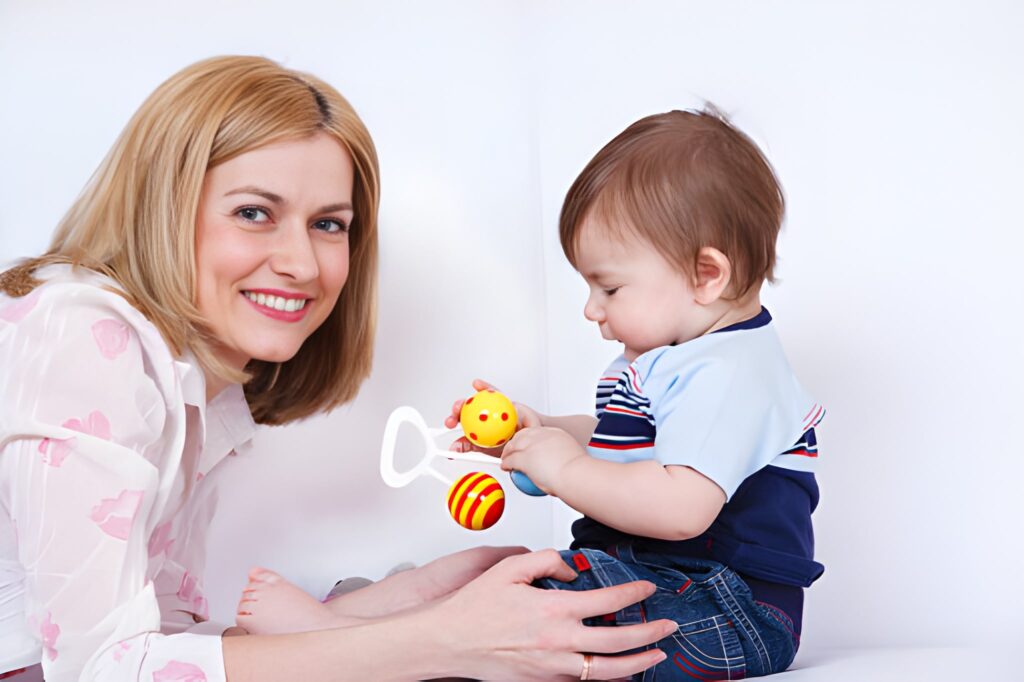
Behavior and Communication: Communication at six months is primarily nonverbal but increasingly intentional. Infants use vocalizations like cooing, gurgling, and babbling to express pleasure or discomfort. They also communicate through facial expressions, gestures, and body movements. Repetitive actions, such as shaking a rattle or banging objects together, indicate exploration and learning through cause-and-effect relationships. Infants at this age begin to show early imitation, copying facial expressions or sounds, which is critical for later language development.
Physical and Motor Development: At six months, infants exhibit improved gross and fine motor skills. They can typically roll over, sit with support, reach for and grasp objects, and bring hands or toys to their mouth. Hand-eye coordination improves, allowing more precise interactions with their environment. Physical growth is steady, and healthy nutrition supports both motor and cognitive development.
Table 1: Key Developmental Milestones for a 6-Month-Old Infant
| Domain | Typical Milestones | Examples |
|---|---|---|
| Cognitive | Recognizes familiar faces, early object permanence, anticipates routines | Reacts to parent approaching, remembers favorite toy |
| Emotional | Expresses joy, anger, fear; stronger attachment | Smiles at familiar caregiver, cries when left alone |
| Social | Engages with caregivers, social referencing, early imitation | Cooing in response to speech, mimicking facial expressions |
| Communication | Cooing, babbling, gestures, vocal experimentation | Babbles “ba” or “da,” reaches for caregiver |
| Physical | Rolls over, sits with support, grasps objects | Plays with toys, brings objects to mouth, reaches accurately |
Psychological Implications: Understanding the psychology of a 6-month-old emphasizes the importance of secure attachment, responsive caregiving, and stimulation through interaction. Infants rely on caregivers to regulate emotions, provide a sense of safety, and encourage exploration. Engaging with the baby through talking, singing, gentle play, and eye contact promotes cognitive and social development, while consistent routines and soothing practices support emotional well-being.
Strategies for Support: Caregivers can support 6-month-old development by providing a safe and stimulating environment, responding promptly to needs, offering age-appropriate toys for exploration, and engaging in interactive play. Reading, singing, and talking to infants fosters early language skills, while physical activities like supervised tummy time strengthen motor skills. Monitoring developmental milestones allows early identification of potential delays, ensuring timely intervention and optimal growth.
Understanding 6-month-old child psychology highlights the interplay of cognitive, emotional, social, and physical development. Supporting infants at this stage lays the foundation for secure attachment, emotional regulation, early communication, and curiosity-driven learning, all of which are essential for lifelong psychological well-being.