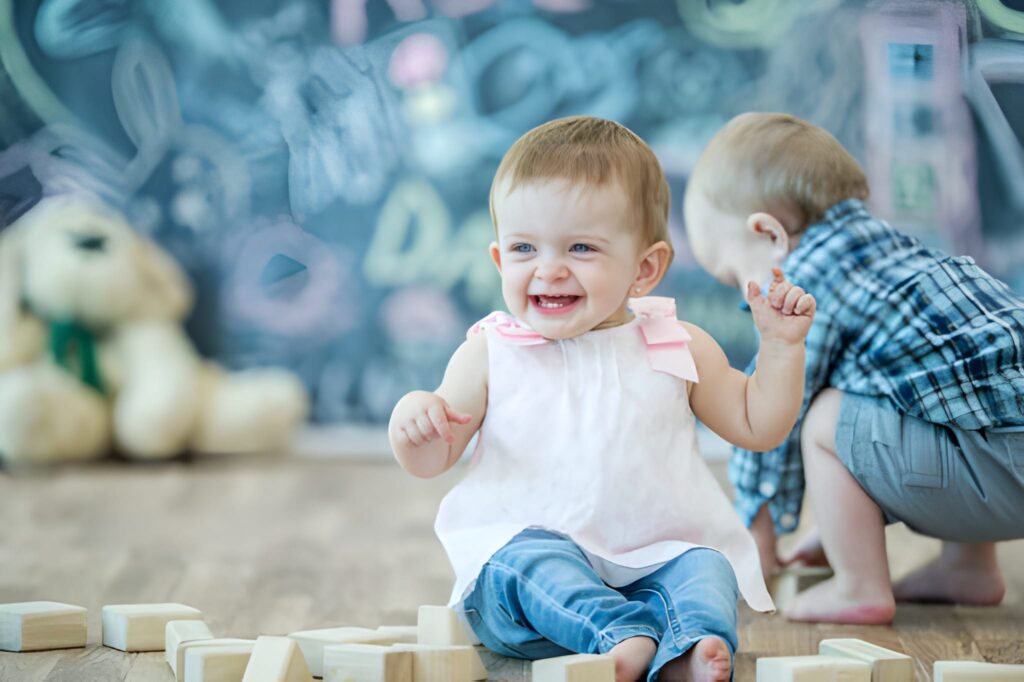
The first year of a child’s life is a period of extraordinary growth and transformation. From a completely dependent newborn to a one-year-old toddler who can sit, crawl, and interact with their surroundings, this stage establishes the foundation for lifelong learning, social skills, and emotional regulation. Understanding 1-year child development enables caregivers and parents to support physical, cognitive, language, social-emotional, and sensory growth effectively.
Physical Development
Physical development in the first year is rapid and encompasses both gross and fine motor skills. By the end of the first year, most children can sit without support, crawl, stand, and may begin walking. Fine motor skills also improve, allowing the child to grasp objects, point, and use both hands more purposefully.
Motor Skill Milestones (12 Months)
| Skill Type | Milestones at 12 Months |
|---|---|
| Gross Motor | Sits independently, crawls, pulls to stand, may take first steps with support |
| Fine Motor | Uses pincer grasp to pick up small objects, transfers objects between hands, bangs toys together |
Cognitive Development
Cognitive development includes learning, problem-solving, memory, and understanding the environment. One-year-olds begin to explore actively, recognize familiar objects and people, and understand simple cause-and-effect relationships.
Cognitive Milestones:
- Searches for hidden objects, indicating early object permanence
- Explores toys in different ways (shaking, banging, throwing)
- Begins to understand simple instructions or commands
- Engages in early pretend play, such as feeding a doll or stacking blocks
Language Development
Language skills in one-year-olds advance from babbling to forming first words and simple gestures. Communication is both verbal and non-verbal, and children begin to express needs, emotions, and preferences.
| Aspect | Milestones at 12 Months |
|---|---|
| Receptive Language | Responds to simple instructions, recognizes familiar words |
| Expressive Language | Says 1-5 words, uses gestures like pointing or waving, imitates sounds |
Social and Emotional Development
Social and emotional growth during the first year involves forming secure attachments, expressing emotions, and beginning to interact with caregivers and peers.
Social-Emotional Milestones:
- Develops strong attachment to primary caregivers
- Shows joy, frustration, or fear depending on context
- Begins to engage in social play, such as peek-a-boo
- Shows preference for familiar people and may exhibit stranger anxiety
Sensory Development
Sensory experiences are crucial for learning and exploration. One-year-olds use sight, hearing, touch, taste, and smell to make sense of their environment.
Sensory Milestones:
- Tracks moving objects visually
- Recognizes familiar voices and responds to them
- Explores textures and objects through touch
- Reacts to different tastes and smells
Factors Influencing 1-Year Child Development
- Genetics: Inherited traits influence physical growth, temperament, and cognitive abilities
- Nutrition: Adequate feeding supports growth and brain development
- Environment: Safe, stimulating surroundings encourage exploration and learning
- Caregiver Interaction: Responsive, consistent caregiving fosters emotional security and social skills
- Health: Timely healthcare and immunizations support overall well-being
Practical Strategies for Supporting 1-Year Development
- Encourage safe exploration and active play to build motor skills
- Offer toys and activities that stimulate curiosity and problem-solving
- Talk, read, and sing to enhance language development
- Provide opportunities for social interaction with peers and caregivers
- Respond consistently to emotional cues to foster secure attachment
- Ensure balanced nutrition and adequate sleep
Conclusion
The first year of life is a critical period of rapid development across all domains. One-year-olds progress in mobility, cognition, language, social-emotional skills, and sensory awareness. Understanding these milestones enables caregivers to provide nurturing, responsive, and stimulating environments that foster optimal growth. By encouraging exploration, communication, and safe interactions, caregivers support children in building the foundational skills necessary for future learning, emotional resilience, and social competence.