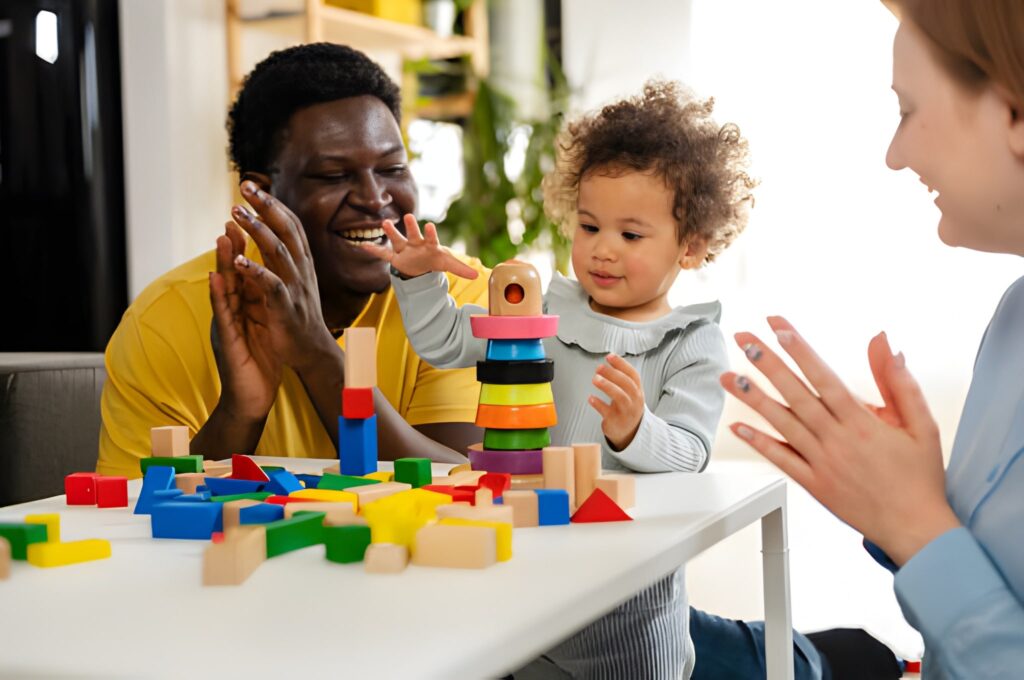
The second year of life is a period of tremendous growth and change. Children transition from dependent toddlers who are just beginning to walk and explore to increasingly independent individuals capable of walking confidently, communicating needs, and experimenting with their environment. Understanding 1-2 years old child development helps caregivers provide age-appropriate support and stimulation across physical, cognitive, language, social-emotional, and sensory domains.
Physical Development (1-2 Years)
During this stage, toddlers refine gross and fine motor skills. Walking becomes steady, running begins, and climbing becomes common. Fine motor skills improve, allowing for self-feeding, stacking blocks, and manipulating small objects.
Motor Skill Milestones
| Age Range | Gross Motor Skills | Fine Motor Skills |
|---|---|---|
| 12-15 months | Walks independently, pulls toys while walking | Picks up small objects, feeds self with fingers |
| 16-18 months | Begins running, climbs onto furniture | Scribbles, stacks 2-3 blocks, turns pages |
| 19-24 months | Runs with more control, kicks ball, walks up stairs with support | Turns doorknobs, stacks 4-6 blocks, uses spoon and fork |
Cognitive Development
Toddlers develop memory, curiosity, and problem-solving abilities. They begin to understand cause-and-effect, imitate adults, and engage in early pretend play.
Cognitive Milestones:
- Explores objects in different ways (shaking, banging, throwing)
- Begins to solve simple problems (finding hidden objects)
- Recognizes familiar people and objects
- Engages in simple pretend play, such as feeding a doll
Language Development
Language skills explode during this period. Vocabulary grows rapidly, and toddlers begin combining words to form simple sentences.
| Age Range | Receptive Language | Expressive Language |
|---|---|---|
| 12-15 months | Understands simple instructions | Says 3-20 words |
| 16-18 months | Follows one-step instructions | Uses two-word combinations, asks for objects |
| 19-24 months | Follows simple two-step instructions | Vocabulary 50-200 words, uses simple sentences and pronouns |
Social and Emotional Development
Social-emotional growth includes forming stronger attachments, experiencing a wider range of emotions, and learning early self-regulation. Toddlers engage in parallel play and begin showing empathy.
Social-Emotional Milestones:
- Shows affection for caregivers and familiar people
- Expresses frustration, pride, or excitement
- Tests boundaries and asserts independence
- Begins to imitate social behaviors of adults and peers
Sensory Development
Sensory exploration continues as toddlers use sight, hearing, touch, taste, and smell to learn about their environment. Coordination improves as they manipulate objects and engage in play.
Sensory Milestones:
- Recognizes familiar sounds and voices
- Explores objects with hands and mouth
- Enjoys tactile play with different textures
- Begins noticing differences in taste and smell
Practical Strategies for Supporting 1-2 Year Development
- Encourage safe exploration and walking/running in secure spaces
- Offer toys and activities that promote problem-solving and fine motor skills
- Talk, read, and sing regularly to expand vocabulary
- Provide consistent routines to help toddlers feel secure
- Model social behaviors, empathy, and emotional regulation
- Introduce simple choices to foster independence
Conclusion
The 1-2 years period is a stage of dynamic growth in all areas of development. Toddlers become more independent, communicative, and socially aware. Understanding the physical, cognitive, language, social-emotional, and sensory milestones of this age enables caregivers to provide appropriate support, fostering confidence, curiosity, and foundational skills for later childhood. Responsive caregiving, enriched play, and a safe environment are essential for toddlers to thrive during this formative period.